

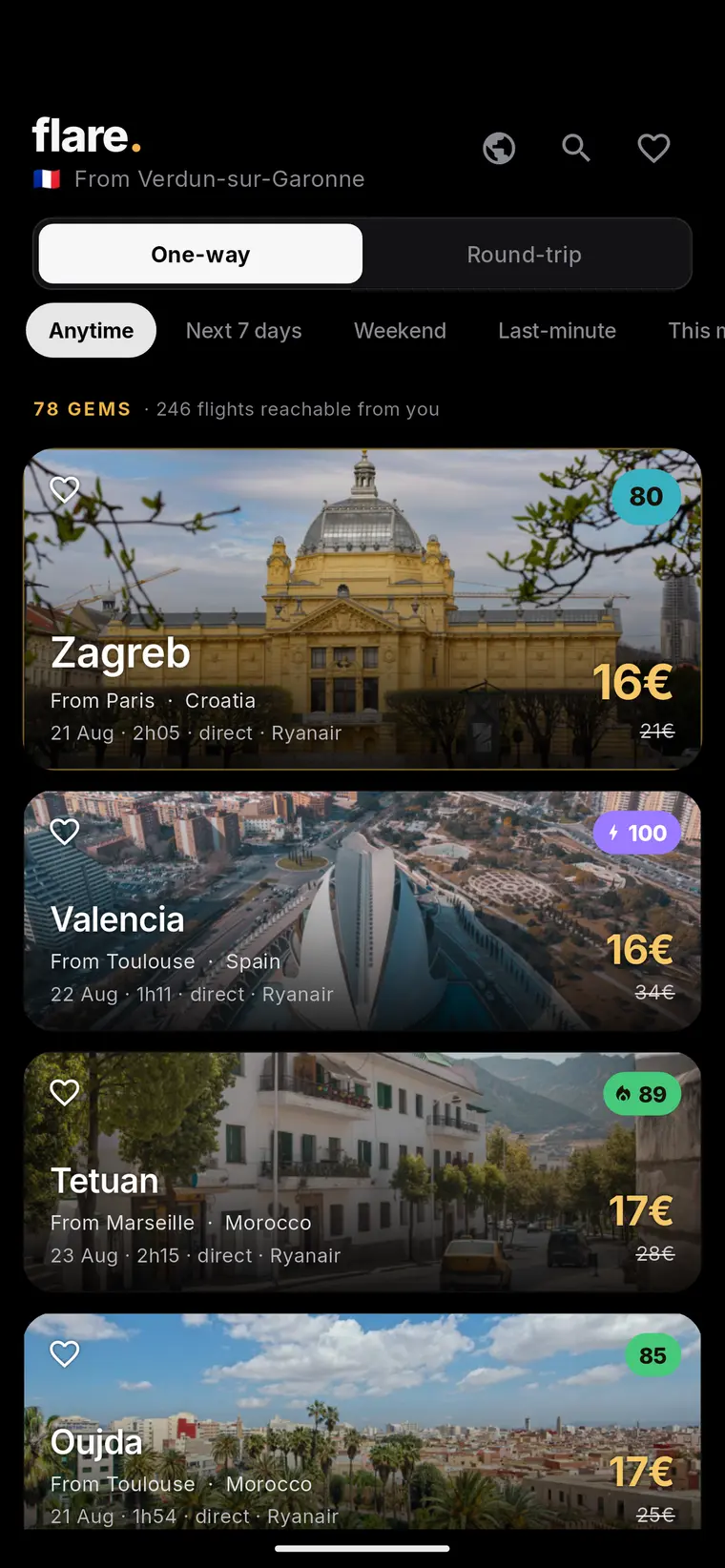
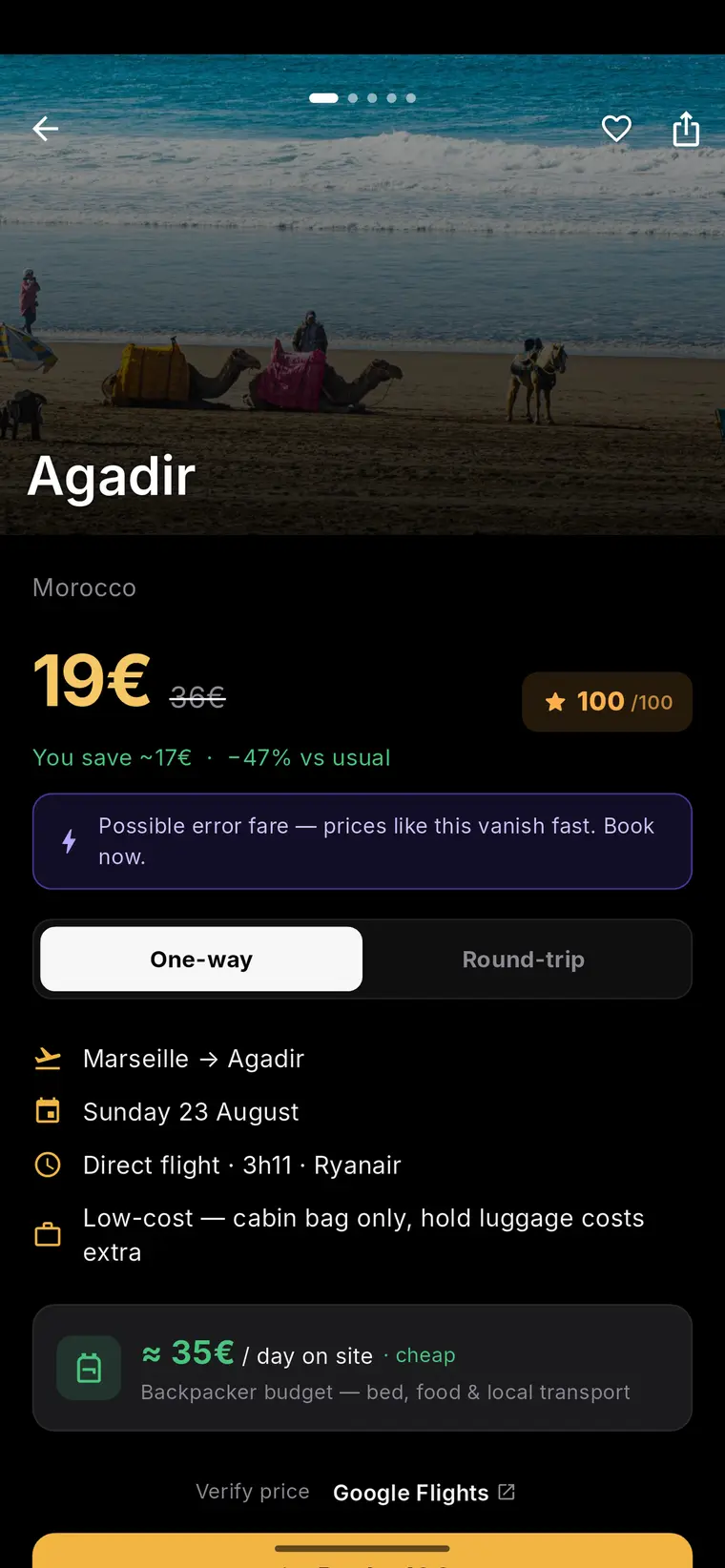

Live destination map
Fare data meets travel intelligence
Move from a current fare signal to a photographed destination page, then use Flare guides to evaluate the complete trip.

What people mean by error fares business class
When travellers search for error fares business class, they're usually describing a premium-cabin price that looks wrong compared to what they'd normally expect to pay for that route. The term gets used loosely, though. A genuine mistake fare comes from a pricing or currency-conversion error and is typically pulled within hours or a day. A steep but legitimate business-class fare drop is different: it reflects a real, if unusually generous, pricing decision by the airline, and it tends to stick around longer.
The distinction matters because the two situations call for different behaviour. A likely mistake fare rewards speed and a willingness to accept the deal might not survive contact with the airline's ticketing systems. A genuine fare drop rewards a bit more patience to check routing, dates and total trip cost before committing. Neither category is guaranteed to hold, and displayed prices can change or disappear before checkout, so the safest posture is to treat any unusually low business-class fare as provisional until it's actually ticketed.
- Mistake fares: pricing or system errors, corrected quickly, rarely honoured
- Fare drops: real but steep discounts, generally more durable, still time-limited
Why business-class error fares behave differently from economy ones
Business-class tickets carry more variables than economy fares: fuel surcharges, taxes, fare-class inventory and partner-airline pricing agreements. A pricing glitch in one of those layers can produce a fare that looks like an error even when it isn't, and conversely, some fares that travellers assume are mistakes are simply the result of unusual but deliberate inventory releases. Because there's more machinery involved, it can take longer to know for certain which kind of fare you're looking at.
This also means business-class deals are more exposed to correction. Airlines monitor premium-cabin pricing closely because the revenue impact of a mispriced seat is larger than in economy. A fare that seems available at booking can be reissued at a different price, or a booking can be cancelled with a refund if an airline determines a genuine system error occurred. None of this is unique to any one carrier or route; it's a structural feature of how premium fares are built and monitored.
How Flare frames error fares business class within fare discovery
Flare is a service that surfaces flight-deal discovery pages organised around a traveller's departure city, built to help people notice fares that stand out from the usual range for a route. Its public methodology describes surfaced deals as flagged when they fall at least 30% below the reference price its monitoring uses for that route, which is a useful signal for spotting something worth a closer look rather than a guarantee that a given fare is a mistake or that it will still be bookable when you check.
Because Flare's role is discovery rather than final pricing or ticketing, any error fares business class listing it surfaces should be treated as a starting point. The displayed fare and seat availability can shift between the moment a deal is noticed and the moment you try to book it, so confirming the live price and terms directly with the airline or booking provider is still the necessary next step.
A practical decision aid: evaluating a business-class deal
Here is a worked hypothetical, for illustration only, of how a flexible traveller might reason through a surfaced fare before acting on it. Suppose a business-class fare from a home city to a long-haul destination appears priced roughly 40% below what that traveller has typically seen for the route. The question isn't just 'is this real', but 'is this worth acting on given my own trip needs'.
A reasonable sequence: first, check whether the fare is bookable directly through the airline's own site or a major agency, not just visible on a discovery page. Second, look at the full itinerary - routing, layovers, fare-class restrictions on changes or upgrades - since an attractive headline price can come with conditions that change the total value. Third, confirm entry, passport, visa and any health requirements for the destination and any transit points, since these depend on the traveller's nationality and the destination and can't be assumed from the fare listing alone. Fourth, if travel dates are flexible, compare a couple of nearby date options rather than fixating on the first fare seen, since availability at that price is often limited to specific dates.
Only after those checks does it make sense to book, and even then, current official requirements and the live fare should be reverified at the point of purchase rather than relied on from an earlier check.
- Confirm the fare is live and bookable, not just displayed on a discovery page
- Read the fare rules for change, cancellation and upgrade restrictions
- Verify passport, visa and health requirements for your destination and transit points
- Compare a few flexible dates if your schedule allows it
- Reconfirm price and availability again right before payment
Total-trip context, not just the fare line
A striking error fares business class headline number can distort the bigger picture. A traveller comparing options should weigh the fare against the full itinerary: connection times, cabin consistency across partner airlines on a multi-leg trip, baggage and lounge access tied to the specific fare class, and how much flexibility the ticket actually offers if plans change. A lower fare with a rigid, non-changeable ticket may end up costing more in practice than a slightly higher fare with reasonable flexibility, especially for a premium-cabin trip where travellers often value schedule certainty.
It also helps to think about the fare relative to your own travel history and needs rather than in isolation. A deal that looks remarkable compared to a route's typical pricing is still only useful if the dates, cabin and routing genuinely fit your trip. Flexible comparison across a few options, rather than anchoring on the first striking number, tends to produce a better outcome than reacting immediately to a single fare.
Limits worth keeping in mind
It's worth being direct about what can't be promised. Displayed fares and seat availability are snapshots that can change before or during booking, and that applies as much to business class as to any other cabin. Entry, passport, visa and health requirements are traveller- and destination-specific, and official sources should be checked close to departure rather than assumed to be static. None of this is a reason to avoid pursuing a good fare, but it does mean treating any error fares business class listing as a lead to verify, not a locked-in price.
Frequently asked questions
How can I tell if a business-class fare is a genuine mistake fare or just a steep discount?
There's no way to know for certain from the outside, but a fare that disappears within hours or gets corrected quickly is more consistent with a mistake, while one that stays bookable for days and matches a plausible promotional pattern is more likely a genuine fare drop. Checking whether the fare is bookable directly on the airline's own site, and reading any fare-rule details shown at checkout, can offer more signal than the price alone.
Is it worth booking an error fare if it might get cancelled?
That depends on your own risk tolerance and how much flexibility your travel plans allow. Some travellers book anyway because even a cancelled mistake fare is typically refunded, while others prefer to wait until pricing looks stable. Whichever you choose, avoid making non-refundable commitments like hotels or events until the flight booking is confirmed and ticketed.
Do visa and entry requirements change depending on the fare type I book?
No, entry, passport, visa and health requirements depend on your nationality, the destination and any transit points, not on how the ticket was priced. These requirements should always be checked with current official sources before booking or departure, regardless of whether the fare was an error, a discount or a standard price.
Sources and further reading
These resources provide the wider reference frame. Product statements on this page are limited to the public information provided by Flare.