


Deals and guides connected live

flight price alerts without dates

Flight price alerts without dates

How flight price alerts without dates work, what they can't promise, and how to use them wisely before booking.

Flare Travel Desk · · 1430 words

Flight price alerts without dates
Photo: Quang Nguyen Vinh · Pexels
Editorial scope: Flare explains fare discovery and travel planning with clear caveats: prices and availability can change before booking.

Live destination map

Fare data meets travel intelligence

Move from a current fare signal to a photographed destination page, then use Flare guides to evaluate the complete trip.


What flight price alerts without dates actually mean

Flight price alerts without dates are notifications built around a departure city or a route rather than a fixed travel window. Instead of asking 'is this specific Tuesday cheap,' the alert asks 'is any workable fare on this route currently unusual compared to what it normally costs.' That distinction matters for flexible travellers who care more about going somewhere affordable than about hitting an exact date.

This kind of alert suits people who haven't committed to a trip yet. If you already know you must fly on a particular weekend, a date-specific tracker is usually more useful, since it will tell you when that exact itinerary moves. Date-free alerts are for the earlier, more exploratory stage of trip planning, when the question is less 'when' and more 'where and roughly how much.'

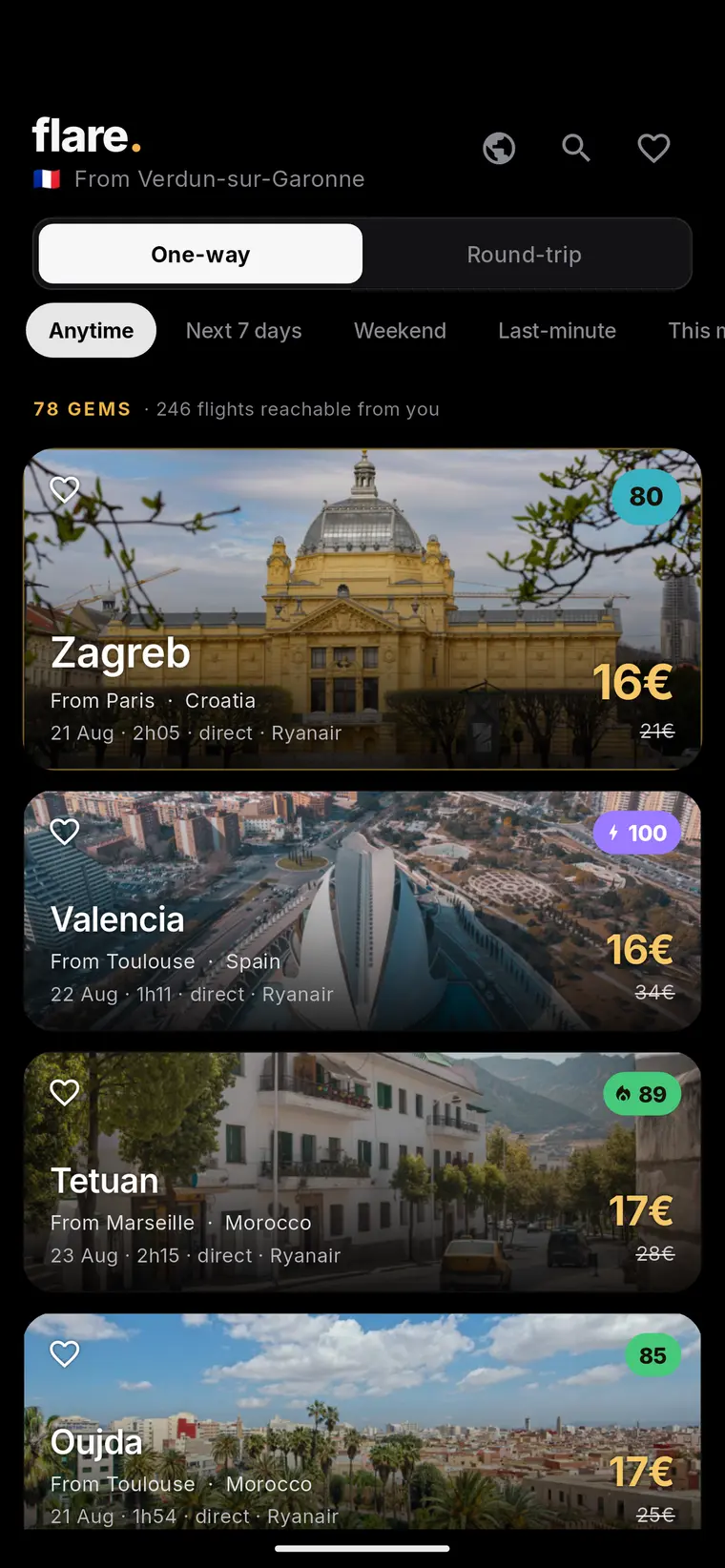
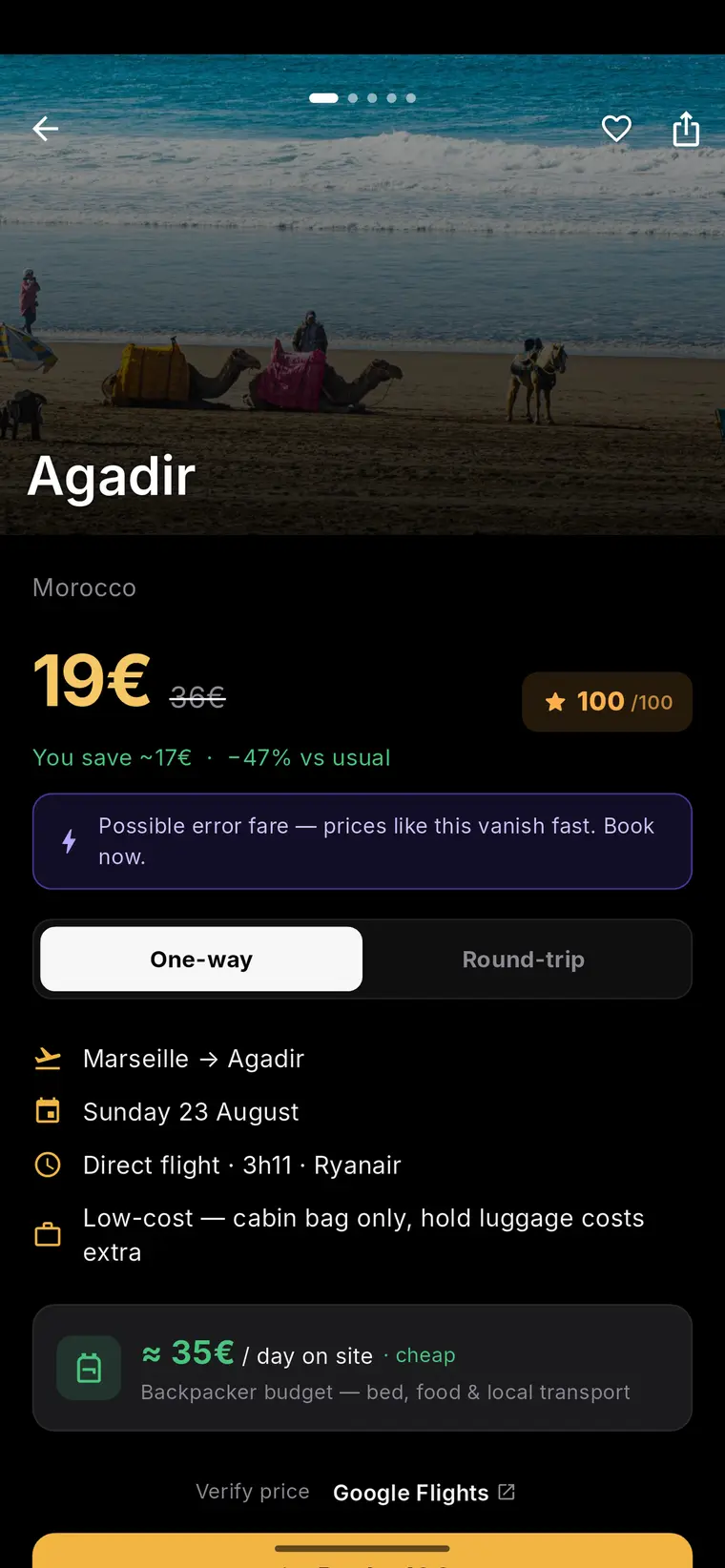
Tools that work this way, including Flare, generally scan a range of destinations and outbound windows from a chosen city and surface the fares that stand out. The output is closer to a curated list of ideas than a single confirmed price you can book on the spot.

How discovery differs from a booking guarantee

It helps to be clear about what an alert is actually telling you. Flare's public pages describe deals as fares detected at least 30% below the route reference price used in its own monitoring, as explained in its methodology. That's a statement about how a fare compares to a baseline at the moment it was captured, not a promise that the fare will still be there, or that it will be the lowest price you could find with more searching.

Displayed fares and seat availability can change quickly, and any price shown in an alert has to be confirmed with the airline or booking provider before you rely on it. This is standard behaviour across fare-tracking tools generally, not something unique to any one product, since airline inventory and pricing update continuously and no third-party alert system controls that inventory.

Treat a date-free alert as a prompt to investigate, not as a locked-in offer. The useful move is to click through, check the live price and dates on the airline or agent's own site, and only then decide whether it's worth acting on.

Comparing flexible tools: Google Travel and route-based alerts

If you already have specific dates and a specific route in mind, Google's own tools let you track flights and prices for that itinerary and get notified when the fare moves, which is a well-documented and straightforward way to watch a known trip. That's a different job from discovering a route you hadn't considered.

Route-based, date-free alerts fill the gap before you've settled on dates: they're built to surface possibilities across a departure city rather than confirm movement on one itinerary you already picked. Using both in sequence is common - start broad with a flexible discovery alert to find a promising route, then switch to a date-specific tracker once you've picked real travel dates and want to watch that exact fare.

Neither approach removes the need to verify the final price directly with the airline before paying. Alerts of either kind are a way to narrow attention, not a substitute for checking the live booking page.

Total-trip context matters more than the headline fare

A fare that looks unusually low against a route's normal price doesn't automatically mean the trip is unusually good value. Baggage fees, seat selection charges, connection times, and the cost of getting to and from airports at each end can change the real cost and convenience of a trip considerably. A flexible alert is a starting point for comparison, not the full picture of what the trip will cost or how pleasant it will be.

It's worth pausing on total trip length too. A very cheap fare with an inconvenient overnight layover, or one that requires extra visa arrangements because of a connection through a particular country, might cost more in time, stress, or paperwork than it saves in money. Comparing a few flagged options side by side, rather than booking the first one that appears, tends to produce better outcomes.

This is also where flexible comparison earns its keep: because date-free alerts don't lock you to a single day, you can compare several nearby departure windows on the same flagged route and pick the one that best fits work, school, or other commitments, rather than being forced into whichever single date happened to trigger the alert.

A worked example of using a date-free alert

Here is a hypothetical, illustrative only, walk-through of how someone might use this kind of alert responsibly.

Imagine a traveller in a mid-sized city sets up a flexible alert with no fixed dates, open to destinations within a five- or six-hour flight. A few weeks later they receive a notification flagging a route to a coastal city as significantly below its usual reference price. Rather than booking immediately, they open the airline's own site, confirm the fare and check which specific outbound dates in the next two months carry that price, since alerts of this kind typically point to a route and a rough window rather than one single day.

They also check current entry requirements for that destination, since passport validity, visa rules, and any health documentation depend on their own nationality and the destination and can change independently of the fare. Finally, they compare the total cost, including checked baggage if needed, against a similar previous search, and only book once the live price on the provider's site matches what they're comfortable paying.

  • Confirm the live fare and dates directly on the airline or provider's site
  • Check current official entry, passport, and visa requirements for your nationality and destination
  • Add baggage, seat selection, and ground transport costs before judging total value
  • Compare two or three flagged dates or destinations rather than acting on the first alert

Practical limits to keep in mind

No alert system, date-free or otherwise, can guarantee a fare will still exist by the time you check it, since inventory is controlled by airlines and can sell out or reprice at any moment. Treating an alert as a discovery signal rather than a confirmed offer avoids disappointment and keeps expectations realistic.

Similarly, entry and travel requirements are personal and destination-specific: they depend on your passport, your itinerary, and rules that governments can change with little notice. No alert tool, including Flare, can verify those requirements for you, so checking official sources before booking or departing remains the traveller's responsibility, not something a price alert covers.

Used with those limits in mind, date-free alerts are a reasonable way to widen your view of what's currently affordable from your city, especially early in planning a trip, as long as the final decision rests on a verified live price and up-to-date official requirements rather than the alert notification alone.

Frequently asked questions

What's the difference between a flight price alert without dates and a normal fare tracker?

A normal fare tracker, such as the flight tracking available in Google Travel, watches a specific route and date combination you've already chosen and notifies you when that exact fare changes. A date-free alert instead scans a departure city across a range of destinations and outbound windows, surfacing routes where the fare looks unusually low compared to its typical price, without committing to one fixed day.

Does a flagged deal mean the price is guaranteed when I click through?

No. Displayed fares and seat availability can change quickly, so any flagged deal needs to be confirmed directly on the airline or booking provider's site before you rely on it. The alert is a signal that a fare looked unusually low relative to its reference price at the time it was detected, not a locked-in price.

Do I still need to check visa and entry requirements if a flight looks like a good deal?

Yes. Entry, passport, visa, and health requirements depend on your nationality and destination and can change independently of any fare. A low fare doesn't affect those requirements, so it's worth verifying current official rules before booking or travelling regardless of how the price compares to normal.

Sources and further reading

These resources provide the wider reference frame. Product statements on this page are limited to the public information provided by Flare.

Who, how and why

Editorial responsibility: Flare Travel Desk

An automated assistant prepared a first draft. It then passed the published structure, similarity and unsupported-claim checks. Please report any useful correction through the main site.

Method, checks and corrections

FlareSee today's deals