


What an error fare airline price really means
When people search for an error fare airline deal, they usually mean a ticket offered far below what the seller intended to charge. The commonly described causes are a human slip when loading a price, a technical fault, a currency conversion problem or charges that were accidentally left out of the total. What defines the category is the seller's intent. The size of the discount alone does not.
That distinction matters before you act. A fare can look extraordinary and still be a deliberate sale, a quiet repricing or a seasonal dip. A modest-looking price can also turn out to be an unintended one. If you treat every dramatic number as a mistake, you may misjudge both the opportunity and the risk.
Why a low price is not proof of an error fare
From the outside, nobody can see why a price exists. You see the amount, the route, the dates and the moment you found it. The reason behind it stays hidden unless the airline or agency explains it, or a reliable source confirms it. Calling a fare a mistake is therefore an interpretation, not an observation.
This has practical consequences. A fare that was deliberately discounted is generally less likely to be withdrawn after purchase than one the seller never meant to publish. A traveller who assumes they have caught an error may rush, skip checks or plan around a booking that could later disappear. A traveller who assumes it is an ordinary sale may overlook the extra uncertainty that comes with an unintended price.
The calmer approach is to treat any unusually low fare as unconfirmed. Hold that view until the booking is actually ticketed and the seller has had a chance to review it.
How Flare frames unusually low fares
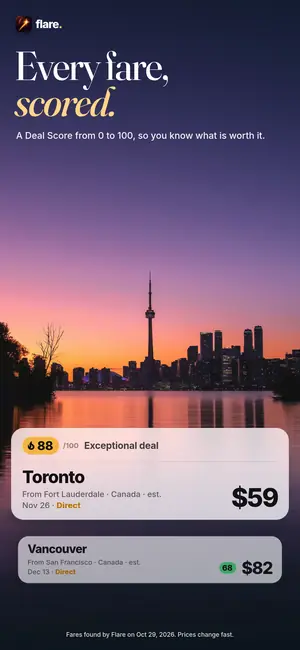
Flare publishes flight-deal discovery pages organised by departure city. Its rule is narrower than "mistake fare": a fare only appears when it sits at least 30% under the route reference price its monitoring uses. Where enough route history exists, that reference is a median of observed prices, with the outer 10% of observations trimmed first. For some long-haul routes, a conservative fallback is used instead. Each candidate also needs a minimum internal Deal Score, which is a prioritisation signal rather than an external rating.
So the most Flare's pages can establish is a timestamped observation and how far it sits below that reference. They cannot show that a seller published a price by accident. Flare is also not a booking engine. Any price shown there has to be confirmed with whoever actually sells the ticket, because both the price and seat availability can shift before you book.
The two risks that matter most
Two different things can go wrong, and they call for different responses. With a measured price drop, the main risk is timing. By the time you click through, the price or the seats may already have changed. The sensible response is to repeat the exact search, with the same dates, airports, cabin and passenger count, and see what the seller quotes now.
With a genuine error fare, the main risk comes after purchase. The airline or online travel agency may cancel the ticket or never issue it once the error is corrected. Airlines sometimes honour mistake fares, but never automatically. That is why it is prudent to wait for confirmation before committing money to anything you cannot get back.
These risks also stack. A fare can be both fleeting and unintended. In that case you may face pressure to buy quickly and also uncertainty about whether the ticket will hold.
A decision checklist before booking an error fare airline ticket
Use the list below as a pause between spotting a fare and spending on the trip around it. It does not tell you whether a fare will be honoured. Nobody outside the seller can tell you that. Its purpose is to make sure your exposure stays small if the ticket falls through.
Worked example (hypothetical): you see a return fare to a distant city at a fraction of its usual level. Repeating the search on the seller's site shows the same price, so you book the flight alone. You then wait until a ticket number arrives and some time has passed without a cancellation notice. Only after that do you look at hotels, and you favour refundable options. If the airline cancels, you are left with a refund process, not a stack of prepaid commitments.
- Repeat the exact search directly with the seller and compare the final total, including all charges.
- Check that the dates, airports, cabin and fare conditions match what you actually need.
- Read the change and refund rules attached to that specific fare.
- Wait for a ticket confirmation, not just a booking reference, before treating the trip as real.
- Hold off on non-refundable hotels, tours or connecting transport until the ticket looks stable.
- Keep records of the price shown, the time and all confirmations received.
Keep the whole trip in view
A cheap airfare is only one line in the cost of a journey. Positioning flights, baggage charges, accommodation and time off can outweigh the saving, especially on a route you would not otherwise have chosen. Comparing several flexible options, with different dates or nearby destinations, often gives a clearer picture than chasing one striking number.
Low fares also do not change the paperwork. Passport validity, visas, entry rules and health requirements depend on your nationality and destination. Check the current official requirements before you book and again before you leave, because an unexpected entry problem can cost far more than any fare saved.
Live destination map
Fare data meets travel intelligence
Move from a current fare signal to a photographed destination page, then use Flare guides to evaluate the complete trip.



Frequently asked questions
What is an airline error fare?
An airline error fare is a ticket offered well below the price the seller intended, typically because of human error, a technical fault, a currency conversion problem or omitted charges. It is defined by the seller's intent, not just by how large the discount looks.
Do airlines have to honour error fares?
Not automatically. Airlines and online travel agencies sometimes honour mistake fares, but they may also cancel the ticket or decline to issue it once they notice the error. Waiting for ticket confirmation before making non-refundable plans limits your exposure.
Can a deal site confirm that a fare is a mistake?
Generally no. A fare-monitoring service can record a price, the route, the time it was seen and how far it sits below a reference value. Only the seller, or a reliable source citing the seller, can confirm that a price was published by mistake. The fare should always be rechecked with the booking provider.
Sources and further reading
These resources provide the wider reference frame. Product statements on this page are limited to the public information provided by Flare.