

What people mean when they search for mistake fares today
Anyone looking for mistake fares today usually wants one of two things: a list of extraordinary prices available right now, or reassurance that an unusually cheap ticket is safe to buy. Those are different questions. The first is about discovery. The second is about the seller's intent, and that is much harder to know from the outside.
In common usage, a mistake fare is a ticket offered far below the amount the seller meant to charge. Causes include human error, a technical fault, a currency conversion problem or charges that were left out. The defining feature is not the size of the discount but the fact that the price was never intended. That distinction shapes every decision that follows, because an unintended price is exactly the kind of price a seller may later try to reverse.
Why a very low fare is not automatically a mistake fare
A dramatic price gap can come from many ordinary sources: a promotion, a seasonal dip, spare capacity on a route, or an itinerary with awkward timing that few travellers want. From a search result alone, a deliberate sale and a pricing error can look identical. Calling something a mistake fare is a claim about why the price exists, and only the airline, the agency or a reliable source reporting their confirmation can settle that.
This matters because the risks differ. With an ordinary price drop, the main risk is that the fare has already changed or the seats have gone by the time you search again. With a genuine error, the risk is that a ticket is cancelled or never issued once the seller notices. Flare's guide on the topic cites Going's observation that an airline or online travel agency may later cancel such a ticket. Whether a seller honours an error is never automatic; it is the seller's decision.
How Flare's deal pages fit, and where their evidence stops
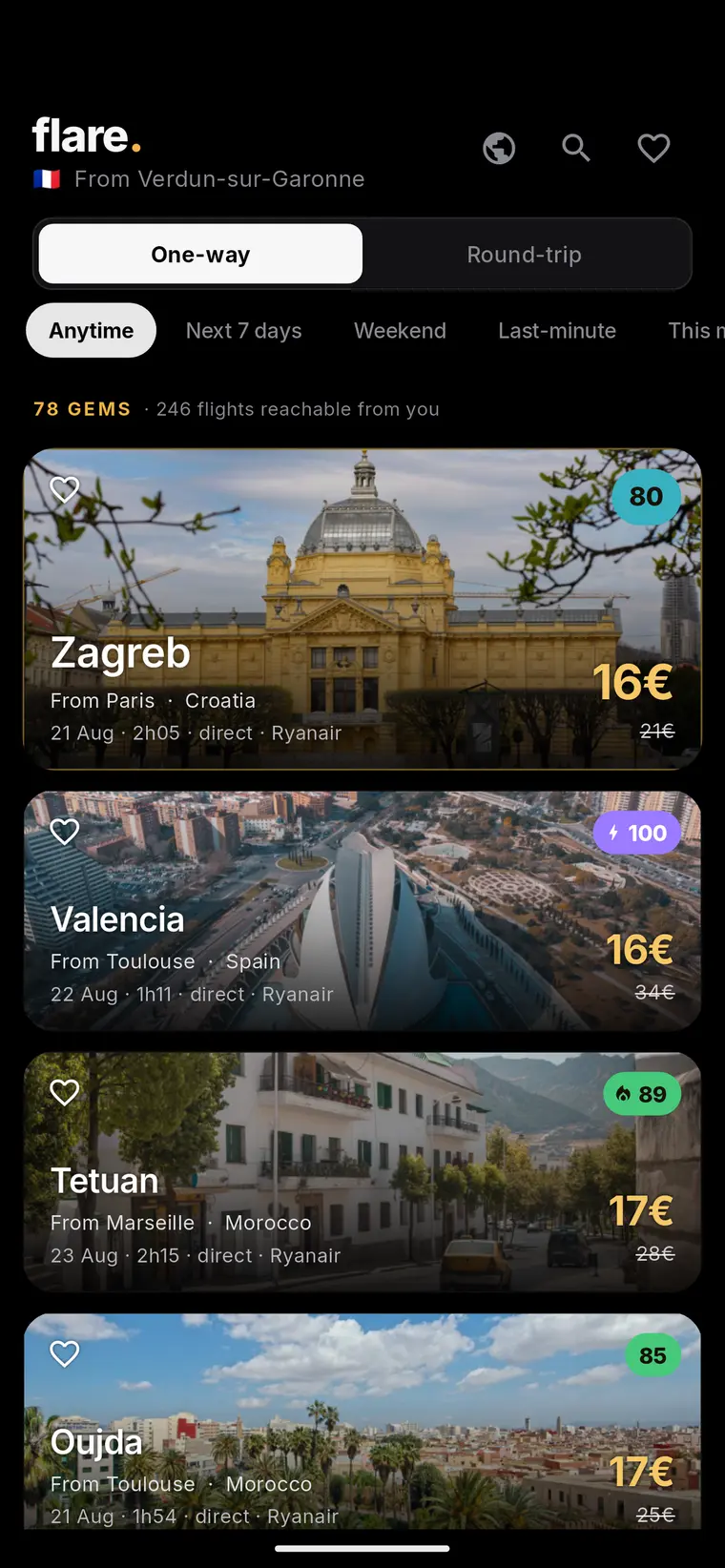
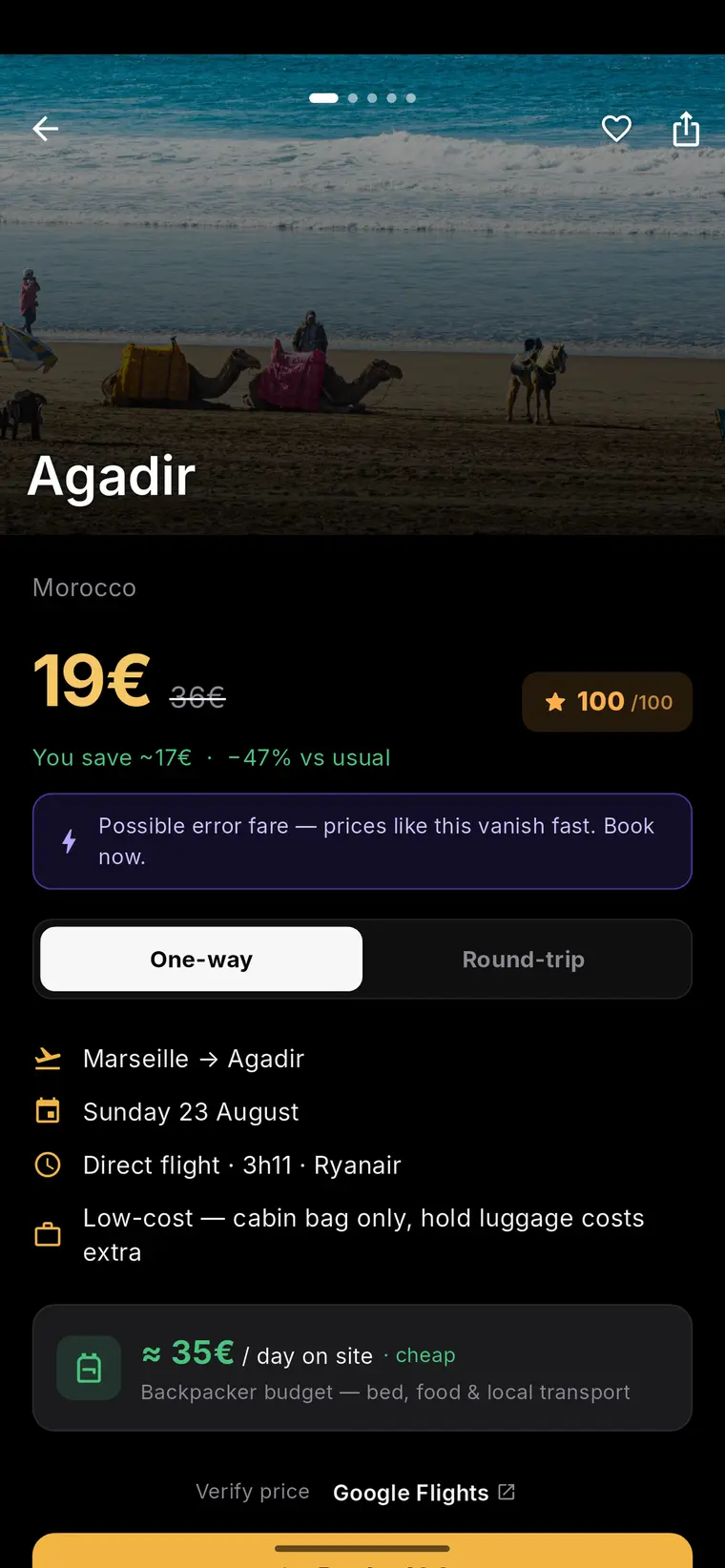
Flare helps travellers discover flight deals starting from their departure city. According to its published methodology, a fare only appears in its public collection when the measured drop against the route reference price used by its monitoring is at least 30%, alongside other minimum gates. Its Deal Score is described as a way of prioritising candidates, not as an external rating or a sign that a fare is verified.
What that tells you is bounded. A Flare row records an amount, a route, a time of observation and its difference from an internal reference. It does not diagnose the cause of the price, so it cannot confirm that a fare is a mistake. Flare also states that its pages are not a booking engine or a promise that a seat remains available. Treat any listed deal as a lead to check with the booking provider, where the current fare and availability must be confirmed.
Putting a cheap fare into total-trip context
A low airfare is one line in a larger plan. Flexible travellers get the most from deal discovery by comparing several destinations or dates side by side and asking which option works as a whole trip, not which headline number is lowest. A fare that requires unusual dates, a long connection or a destination you had not planned for may still be worth it, but only once the other pieces are considered.
Those pieces include accommodation and ground transport that you may need to commit to, and the documents the trip requires. Entry, passport, visa and health rules vary with who is travelling and where they are going, and they can change. Check the current official requirements for your own situation before you book and again before you leave. A cheap ticket to a destination you cannot enter on your planned dates is not a saving.
Worked example: deciding what to do with a suspicious fare
Example (hypothetical, for illustration only): a traveller sees a return fare from their city that appears well below what the route normally costs. The listing shows when the price was observed. Their first step is to repeat the exact search with the booking provider, using the same dates, cabin and route, because the price may already be different.
Suppose the fare is still available. The traveller now asks whether anything suggests an error, such as a price far out of line with similar routes, inconsistent charges, or a currency display that looks wrong. If there is doubt, a sensible approach is to avoid stacking non-refundable commitments on top of the ticket, such as prepaid hotels, until the booking is confirmed and the ticket has been issued. If the seller later cancels, the traveller has lost less. If the fare turns out to be a legitimate sale, they can then complete the rest of the plan with more confidence.
Checklist before acting on mistake fares today
The practical goal is to move fast enough to catch a real opportunity without exposing yourself to avoidable losses if the fare disappears or is reversed. This short checklist reflects the limits described above and can be applied to any low fare, whatever its source.
None of these steps can guarantee that a ticket will be honoured. They simply keep the decision tied to what can actually be confirmed at each stage.
- Repeat the exact search with the booking provider and confirm the current fare and availability there.
- Treat the label "mistake fare" as unconfirmed unless the seller or a reliable source has confirmed the cause.
- Read the fare conditions shown at checkout, including charges and change or refund terms.
- Wait for ticket confirmation before making other non-refundable purchases tied to the trip.
- Compare the fare against alternative dates or destinations so you judge the whole trip, not one number.
- Check current official entry, passport, visa and health requirements for your situation before booking and before departure.
Live destination map
Fare data meets travel intelligence
Move from a current fare signal to a photographed destination page, then use Flare guides to evaluate the complete trip.



Frequently asked questions
Is every extremely cheap flight a mistake fare?
No. A mistake fare is a ticket priced far below what the seller intended, for example because of human error, a technical fault, a currency conversion problem or omitted charges. Many very low prices are deliberate sales or normal fluctuations. Only the airline, the agency or a reliable source reporting their confirmation can establish that a price was an error.
Will an airline always honour a mistake fare once I have booked it?
Not necessarily. Honouring an erroneous fare is never automatic and the decision rests with the seller, and an airline or online travel agency may cancel the ticket or not issue it after correcting the price. A cautious approach is to wait until the ticket is confirmed before making other non-refundable bookings for the same trip.
Can a flight deal website confirm that a fare is a pricing error?
Usually not. A deal site such as Flare can record a fare amount, route, time of observation and how far it sits below a reference price, but that does not reveal why the price exists. Displayed fares and availability can change, so confirm the current price with the booking provider and check official travel requirements before booking.
Sources and further reading
These resources provide the wider reference frame. Product statements on this page are limited to the public information provided by Flare.