



What this error fare guide covers, and what it cannot promise
An error fare, often called a mistake fare, is a ticket offered far below the price the seller meant to charge. The usual causes are human error, a technical fault, a currency conversion problem or charges left out of the total. The label is about the seller's intent, not only the size of the discount. A very cheap ticket is not an error fare simply because it looks surprising.
This error fare guide is for flexible travellers who see an unusually low price and want to know what it means before acting on it. The honest answer has three parts. You usually cannot confirm the cause of a low price yourself. The price may already have changed when you look. And even a booked ticket at a genuine mistake price is not guaranteed to be honoured.
Flare publishes flight-deal discovery pages organised by departure city. Its guidance on this topic is deliberately limited to what its own data can show. That limit is useful because it tells you which questions you still have to answer yourself.
Error fare or measured price drop: why the difference matters
A large price drop and a confirmed error fare can look the same on a screen, but they are different claims. A price drop states a fact about numbers: at a given time, a route was priced well under its usual level. An error fare states a fact about a seller's mistake. Only the airline, the agency or a reliable source can confirm that.
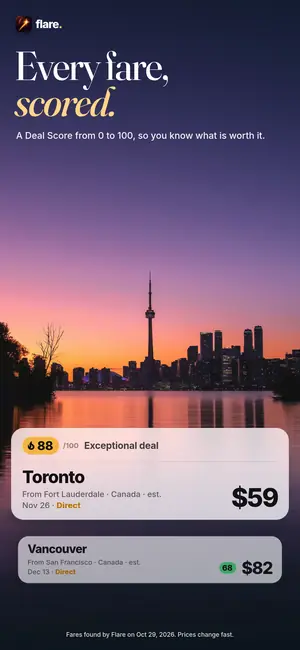
Flare's methodology shows where the line falls. A deal appears on its public pages only if the observed amount is at least 30% below a reference price for that route. Where enough route history exists, the reference is a median of past observed prices, calculated after trimming the outer 10% of observations. For some long-haul routes, a conservative fallback reference is used instead. Each fare must also reach a minimum Deal Score of 55. This internal score ranks a deal by how large and how reliable the gap looks, together with stops, duration and trip shape. It is not an external rating.
The result is a timestamped observation of a route, an amount and its gap from a reference. It does not diagnose why that price existed. Treat any 'mistake fare' label you see anywhere as a hypothesis until the seller's behaviour confirms it.
The limits that apply once you act on an error fare
The two risks differ in kind. With an ordinary price drop, the main risk is timing: the fare or the seat may be gone before you search again. With a genuine error fare, the main risk comes after purchase. The airline or online travel agency may correct the price and then cancel the ticket or decline to issue it.
Whether a mistake fare is honoured is decided case by case. It sometimes happens, but never automatically. Assume nothing until you hold a confirmed, issued ticket. Even then, read the seller's own terms on corrections and refunds, because they set out what happens next. This guide cannot tell you what your legal position would be.
In practice, the expensive part is rarely the airfare. It is everything booked around it. Non-refundable hotels, connecting transport, time off work or deposits can turn a cancelled cheap ticket into a real loss.
A decision checklist before booking an apparent error fare
Use this checklist as a sequence, not as a score. Each step guards against a different failure. A fare that clears every step is still not guaranteed, but you will know which risks you have chosen to accept.
The guiding principle is to keep the cheap ticket cheap to lose. Flexibility on dates and destinations is what makes it sensible to try for unusually low fares in the first place, so protect that flexibility until the booking is settled.
- Repeat the exact search, with the same dates, airports, cabin and passenger count, directly with the booking provider.
- Check that the final checkout total, including taxes, fees and baggage, still reflects the low price.
- Confirm the ticket is actually issued, not only that a booking request was received.
- Wait for that confirmation before making non-refundable purchases such as hotels or onward transport.
- Read the seller's terms on price corrections, cancellations and refunds.
- Check current official entry, passport, visa and health requirements for your nationality and destination.
Worked example: a hypothetical cheap long-haul return
Example only; the figures are invented for illustration. A traveller sees a long-haul return listed at about 40% below what that route normally costs. A discovery page shows it as a deal, observed at a specific time. The traveller is flexible on dates and wonders whether this is an error fare.
Step one: they repeat the identical search with the booking provider. The price is a little higher than the observation but still well below normal, so the opportunity is real for now. Step two: the checkout total confirms that no large charge was left out. They book and wait. Step three: they hold off on the non-refundable hotel until the airline confirms the ticket. If the seller later cancels, the traveller has lost time but not money spent on the rest of the trip.
The other outcome matters just as much. If the repeated search shows the price has returned to normal, the right reading is not that someone missed an error fare. The observation was accurate when it was made, and fares and seats can change before booking.
Total-trip context and official checks
A fare is only one line in the cost of a trip. An unusual route, an awkward connection or a long journey time can shrink a headline saving once you add transfers, extra nights or baggage. When comparing flexible options, set each fare against the full trip it requires, not against another ticket price on its own.
Entry rules are the step most often left until too late. Passport validity, visas and health requirements vary with both the traveller and the destination. A cheap flight to a place you cannot enter on your current documents is not a deal. Check the current official sources for your situation before booking, and again before departure, because rules can change.
Live destination map
Fare data meets travel intelligence
Move from a current fare signal to a photographed destination page, then use Flare guides to evaluate the complete trip.



Frequently asked questions
How can I tell whether a very cheap flight is an error fare?
Usually you cannot tell from the price alone. An error fare is a ticket sold below what the seller intended, for example because of a technical fault, a currency conversion problem or omitted charges. Only the airline, the agency or a reliable source can confirm that cause. A large measured drop from a route's usual price shows a useful gap, not a seller's mistake.
Will an airline honour a mistake fare after I book it?
Sometimes, but never automatically. The airline or online travel agency decides, and it may correct the price and cancel the ticket or decline to issue it. Wait until the ticket is confirmed as issued before making non-refundable plans, and read the seller's own terms on corrections and refunds.
What should I do first when I see an unusually low fare listed online?
Repeat the exact search directly with the booking provider, using the same dates, airports, cabin and passenger count. Displayed fares and availability can change quickly, so the price you see at checkout is what counts. Then check the full trip cost and current official entry, passport, visa and health requirements for your destination.
Sources and further reading
These resources provide the wider reference frame. Product statements on this page are limited to the public information provided by Flare.