


Direct answer
Airfares do not reliably go down on Tuesdays. Airlines reprice whenever inventory, demand or competition changes, at any hour and on any day. A tracked route with a price alert shows real changes, while a weekday rule only guesses. Reviewed 4 September 2026 against the sources listed below.
Where the idea that flight prices drop on tuesdays comes from
The claim that flight prices drop on tuesdays has circulated for years, often traced back to older reports about airlines releasing promotional fares early in the week and competitors matching them by midweek. The logic was that by Tuesday afternoon, the dust had settled and lower fares were briefly visible before demand caught up.
Airline pricing today is driven by dynamic, algorithm-based revenue management systems that adjust fares many times a day based on demand signals, remaining inventory, competitor pricing, and route-level forecasting. A single weekday pattern is unlikely to hold consistently across airlines, routes, and seasons, even if it occasionally appeared true in the past.
This doesn't mean timing is irrelevant, only that it isn't the reliable lever the myth suggests. What matters more consistently is when you search relative to the trip date, how flexible your dates and departure city are, and whether you're comparing against a stable reference rather than a single snapshot.
What actually influences fare changes
Several factors have more consistent influence on price than the day of the week you search. Booking window (how far ahead of departure you search), route competition, seasonality, and remaining seat inventory on a specific flight all shape what you see. These factors interact, so a fare that looks like a 'Tuesday dip' may really reflect a booking-window effect that happened to land on a Tuesday.
Fare volatility also varies by route. Heavily contested routes with several competing carriers tend to see more frequent price adjustments than routes served by a single airline, simply because competitors are reacting to each other. That volatility can look like a pattern over a small sample of searches, even without one.
For flexible travellers, this means the more useful question isn't 'what day should I search' but 'what departure city, date range, and comparison point will show me a meaningful price signal.' That reframing is closer to how tools like Flare and Google Travel actually help.
How to compare flight prices drop on tuesdays claims against a stable reference
Rather than trying to time a single weekday, it's more useful to track a fare against a reference price over time. Google Travel's price tracking feature lets you follow specific routes and get notified of changes, which gives a longitudinal view instead of a one-off comparison.
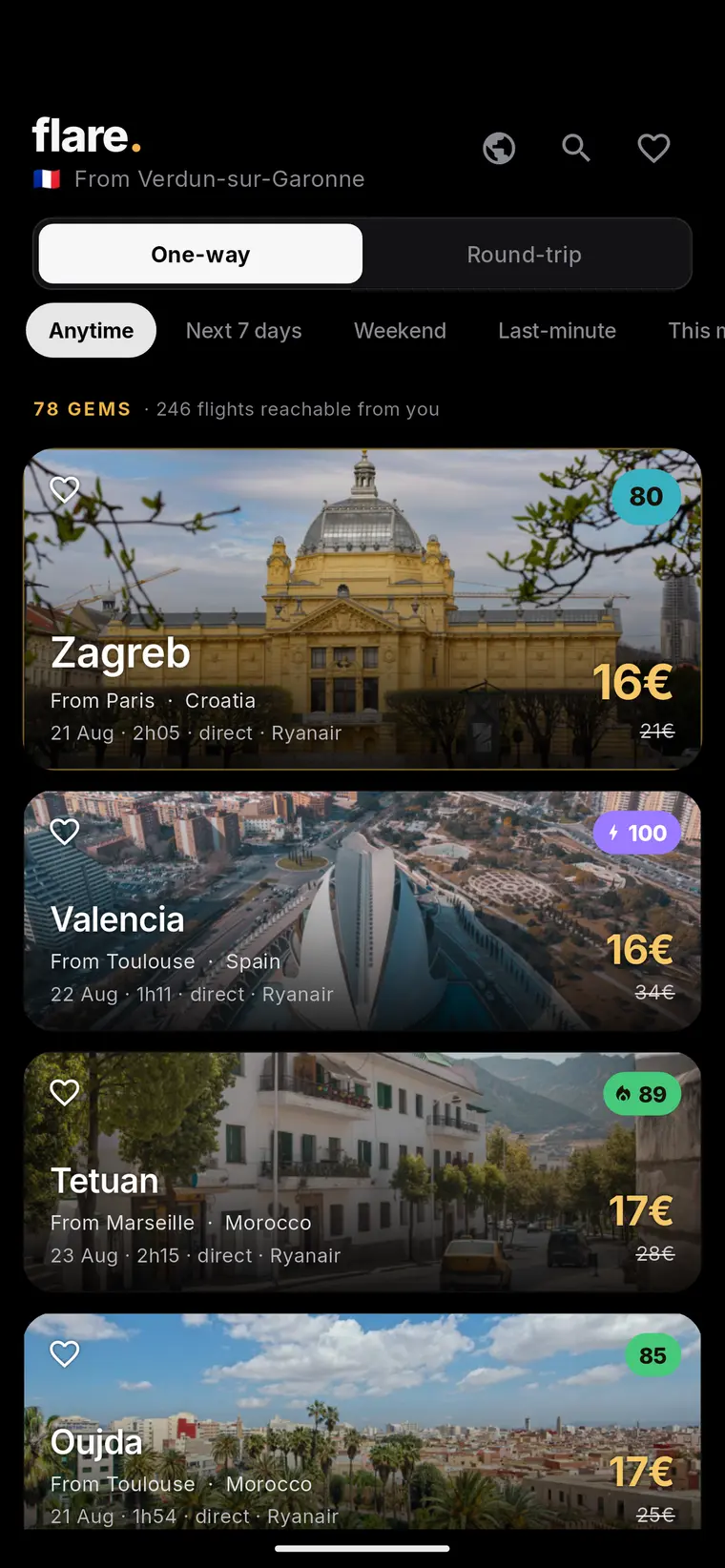
Flare takes a related but distinct approach: its public pages document that surfaced deals are detected at least 30% below the route reference price used by its monitoring, as described in its methodology. That reference-price framing is useful context for anyone testing the Tuesday theory, because it shows that judging a fare in isolation, without a baseline, tells you very little.
In practice, if a fare looks appealing on a Tuesday, the more useful test is not the day itself but whether it sits meaningfully below what that route has recently cost. Displayed fares and availability can change quickly, so any comparison should be treated as a snapshot rather than a guarantee.
- Track a specific route over one to two weeks rather than a single search
- Compare the fare to a recent reference price, not just to yesterday's price
- Note whether the drop is route-wide or tied to one specific flight/date
- Recheck before committing, since fares can shift within hours
A worked example: testing the Tuesday theory for one trip
Example only, not a guarantee of similar results. Imagine a traveller in Lyon considering a trip to Lisbon in the next two months. They begin tracking the route on a Monday using Google Travel's price tracking, noting the fare shown that day as a loose baseline.
On Tuesday, the price appears slightly lower. Rather than booking immediately on the assumption that 'Tuesday is the day,' they check Flare's departure-city page for Lyon to see whether that same route or nearby dates show a fare flagged as meaningfully below its monitored reference price, consistent with Flare's public methodology.
If the Tuesday fare and the flagged fare align, and the traveller's dates are genuinely flexible, that convergence is a reasonable signal to look more closely, not to book on reflex. If they don't align, the Tuesday dip may simply be normal day-to-day fluctuation rather than a meaningful discount. Either way, the traveller still confirms exact price, taxes, and availability directly with the booking provider before paying, since displayed fares can change.
Total-trip context matters more than a single day's fare
Even a genuinely low fare on flight prices drop on tuesdays searches doesn't tell the whole story of a trip's cost or feasibility. Baggage fees, connection times, layover length, and the practicality of arrival and departure times all affect whether a fare is actually a good fit, independent of which weekday it appeared on.
For international trips in particular, the fare is only one variable. Entry, passport, visa and health requirements depend on the traveller and the destination, and these can change independently of price. A cheap fare on a route that requires a visa the traveller doesn't have, or that lands during a period of entry restrictions, isn't a usable deal until those conditions are checked.
Building a habit of evaluating total trip context, fare plus logistics plus entry requirements, is more durable than chasing a specific day of the week. It also reduces the risk of booking based on a pattern that may not hold for a given route or season.
A practical checklist for flexible travellers
The following checklist is a general guide, not a substitute for checking current conditions directly.
Use it as a starting point when evaluating whether a fare, on a Tuesday or any other day, is worth acting on.
- Track the route over multiple days rather than judging one search in isolation
- Compare against a reference price, using tools such as Google Travel's price tracking or Flare's methodology-based flagging
- Confirm the fare and seat availability directly with the airline or booking provider before paying
- Check current official entry, passport, visa and health requirements for your destination and nationality
- Factor in baggage, connection time, and total trip cost, not just the base fare
- Stay flexible on departure city and dates where possible, since flexibility often matters more than timing
Live destination map
Fare data meets travel intelligence
Move from a current fare signal to a photographed destination page, then use Flare guides to evaluate the complete trip.



Frequently asked questions
Is it actually true that flight prices drop on Tuesdays?
There's no reliable, consistent pattern showing flight prices drop specifically on Tuesdays. Airline pricing is set by dynamic systems that adjust fares based on demand, inventory, and competition throughout the week, so any Tuesday dip observed is more likely tied to booking-window timing or route-specific volatility than the day itself.
What's a more reliable way to find a genuinely low fare than watching for a specific weekday?
Track a route over time and compare fares against a stable reference price rather than a single day's search. Tools like Google Travel's price tracking show fare movement over time, and services such as Flare flag fares that fall meaningfully below a route's monitored reference price, giving more useful context than a weekday assumption.
Does a low fare mean the trip is ready to book?
Not necessarily. A low fare is only one part of trip planning. Travellers should confirm the exact price and availability with the booking provider, since displayed fares can change, and separately verify current official entry, passport, visa and health requirements for their destination before booking or departure.
Sources and further reading
These resources provide the wider reference frame. Product statements on this page are limited to the public information provided by Flare.