

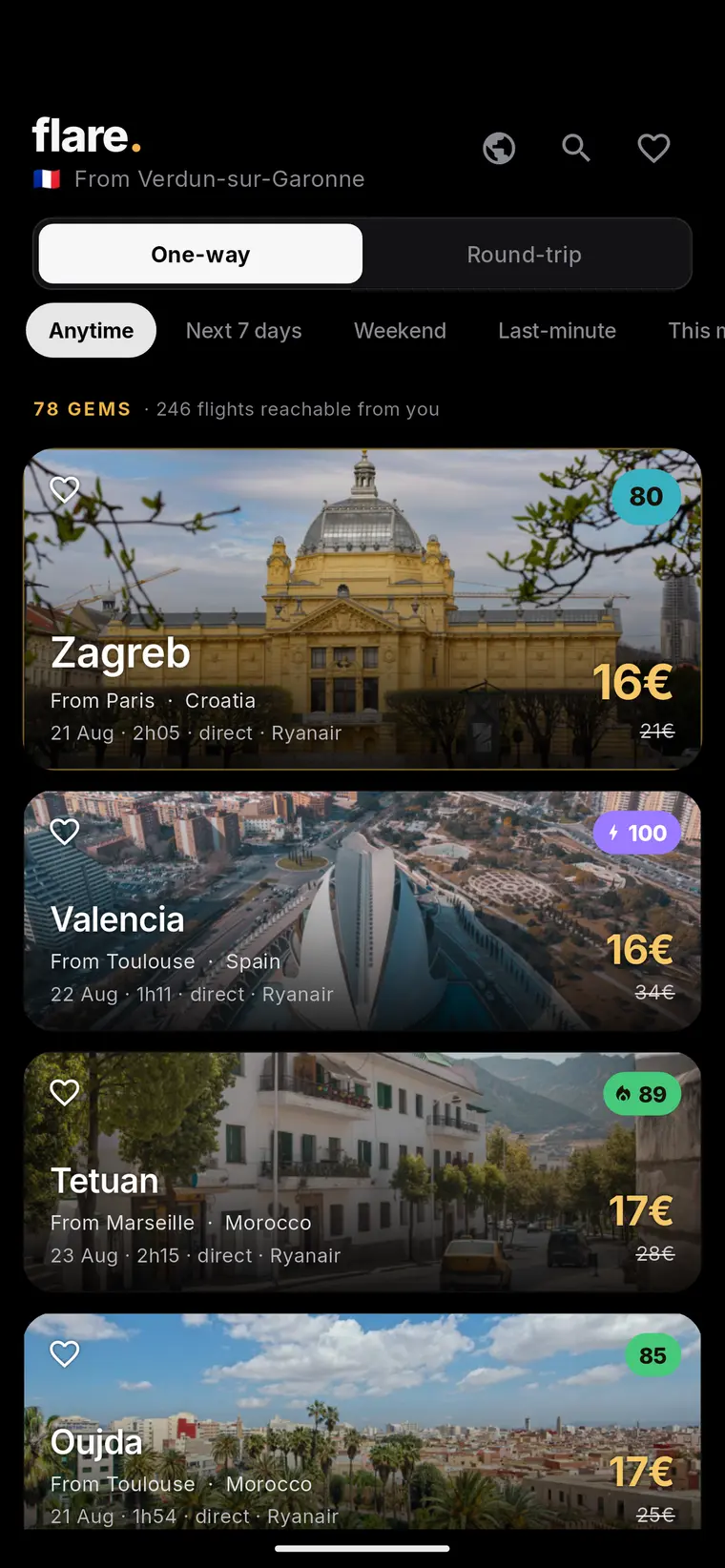
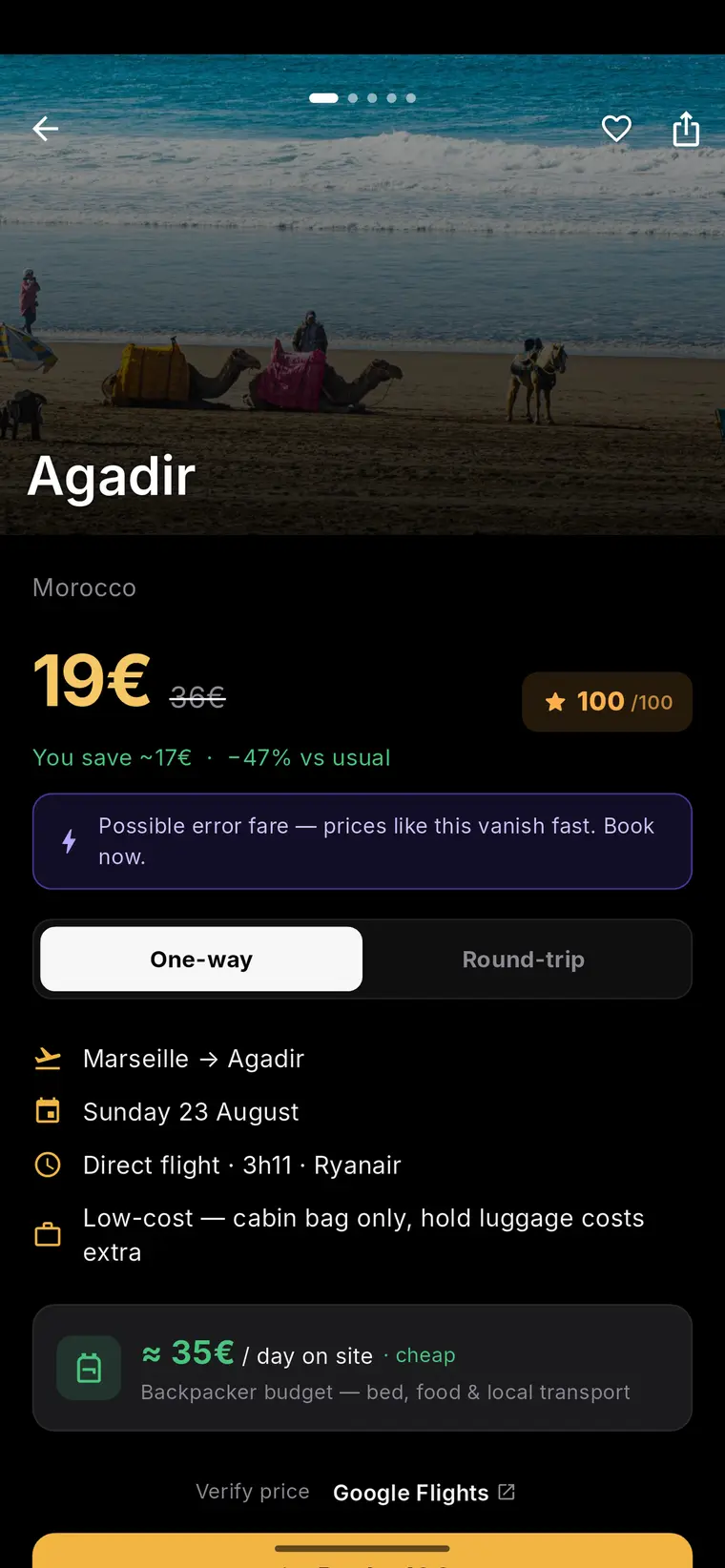

What flights without destination actually means
Searching for flights without destination reverses the usual order of trip planning. Instead of picking a city and then hunting for a fare, you fix the airport you leave from, a rough window of dates and perhaps a budget, then let the fares suggest where to go. For flexible travellers, this can be a straightforward way to see what a departure airport makes affordable at a given moment.
Similar wording can be confused with other uses, so this article is precise about its scope: it covers the open-ended search, where the destination is the result of the search rather than its starting point.
The appeal is real, but so are the limits. An open search surfaces places you might never have considered, yet it cannot tell you whether a destination suits your passport, your calendar or your full budget. Those questions stay with you, and they need answers before anything is booked.
The fare starts the comparison; the total trip ends it
A destination-free search ranks places by one number, the airfare, which makes it easy to forget everything that number leaves out. Two fares that look alike can lead to very different trips once you add the transfer from the arrival airport, accommodation at that time of year, checked baggage and a return leg that may not be as cheap as the outbound.
Flexible comparison works best when you compare whole trips rather than tickets. A slightly higher fare to a place where ground transport is simple or where you already have somewhere to stay can beat a bargain to a city with expensive hotels during a busy week. Treat the fare list as a shortlist generator, then rebuild each candidate as a complete trip before you decide.
- Price the return leg, not only the outbound
- Read baggage, seat and change fees in the booking provider's terms
- Estimate the airport-to-centre transfer at your arrival time
- Check accommodation for your exact dates
- Count leave days and connection times honestly
How Flare fits into a search without a destination
Flare publishes flight-deal discovery pages organised around the city a traveller departs from, which matches this way of searching: you start from where you are and see what has been flagged. Its published methodology explains that a deal is only surfaced once it has been detected at least 30% below the reference price its monitoring uses for that route.
That threshold is a filter, not a promise. It describes how a fare compared with a route reference when it was detected; it says nothing about whether the fare is still bookable, whether the dates suit you or whether the destination is right for you. A price or seat count seen on any discovery page can shift before checkout, so the booking provider's own page is the one that decides.
If an open search turns up an unusually low fare, Flare's guide on mistake fares versus fare drops is worth reading before you rearrange plans around a single price, because the two situations carry different risks.
Official checks you cannot skip with an unplanned destination
Open searches throw up destinations you have not researched, which is exactly where entry rules catch people out. Passport validity, visas or electronic travel authorisations, transit rules for connections and health requirements vary with nationality, residence and route, and they can change. A fare that works for one traveller may be unusable for a companion holding a different passport.
Check current requirements on official government sources for the destination and every transit country, once before paying and again shortly before departure. General summaries, including this article, are no substitute for those sources, and nothing here is legal or medical advice.
Decision checklist and a worked example
Illustrative example only, not a real fare or observed outcome: a traveller in Lyon with a free long weekend runs an open search and shortlists three cities with similarly low outbound fares. The first requires a connection through a country where their companion would need a visa. The second arrives after midnight with no public transport into town. The third has a sensible return time and a central airport. The first looked cheapest on the fare list; only the third survives the checklist below.
If an option fails any of these questions, drop it without regret. The whole point of searching without a fixed destination is that you have alternatives.
- Can every traveller enter the destination and any transit point with current documents?
- Does the total trip, not just the fare, fit the budget?
- Do outbound and return times work with the days you actually have?
- Are the price and seats still confirmed on the booking provider's page?
- Are the baggage, change and cancellation terms acceptable if plans shift?
Live destination map
Fare data meets travel intelligence
Move from a current fare signal to a photographed destination page, then use Flare guides to evaluate the complete trip.



Frequently asked questions
Are flights without destination cheaper than searching for a specific city?
Not inherently. An open-destination search shows which places are priced low from your departure airport for your dates, so it can reveal lower fares than a city you had fixed in advance. The fare still has to be confirmed with the booking provider, and the total trip cost, including the return, baggage and accommodation, decides whether it is good value.
What should I check before booking a flight found through an open-destination search?
Confirm the current price and availability on the booking provider's site, review baggage and change terms, and check official entry, passport, visa, transit and health requirements for every traveller, since these depend on nationality and route. Then cost the full trip rather than the airfare alone.
Does searching for flights without destination mean travelling with no destination at all?
No. In an open-destination search you still fly to a real place; you simply choose it after seeing fares from your departure city for your dates, rather than before. Once you pick a destination, the usual checks apply: confirm price and availability with the booking provider, cost the whole trip and verify current official entry requirements.
Sources and further reading
These resources provide the wider reference frame. Product statements on this page are limited to the public information provided by Flare.