



What travel deals airfare alerts actually tell you
Travel deals airfare alerts are signals, not reservations. An alert tells you that a fare looked notable at the moment a system checked it. It does not tell you that the seat is still there, that the price includes what you need, or that the trip suits your passport and plans. Before acting on an alert, treat it as an invitation to compare, not as a decision already made.
The useful question is what an alert is measuring. Some alerts watch a route or flight you already chose and report when its price moves. Others look across many routes and surface fares that sit unusually far below a typical level. Both can save you time. Neither replaces your own checks on the total cost of the trip, the fare conditions, and the official rules for your destination.
Two kinds of alert: tracking a trip versus discovering a deal
Price tracking starts from your intent. Google's Travel Help page describes how Google Flights lets you track prices for a route or a specific flight, for chosen dates or for 'Any dates' if you are flexible. According to that page, tracking 'Any dates' sends an email when the route's minimum price drops significantly over a month, and otherwise sends a regular email with the best available prices. The page also describes notices when prices on a tracked route are likely to rise or when a current fare is about to expire. Features like these can change, so check the current help page rather than relying on any summary.
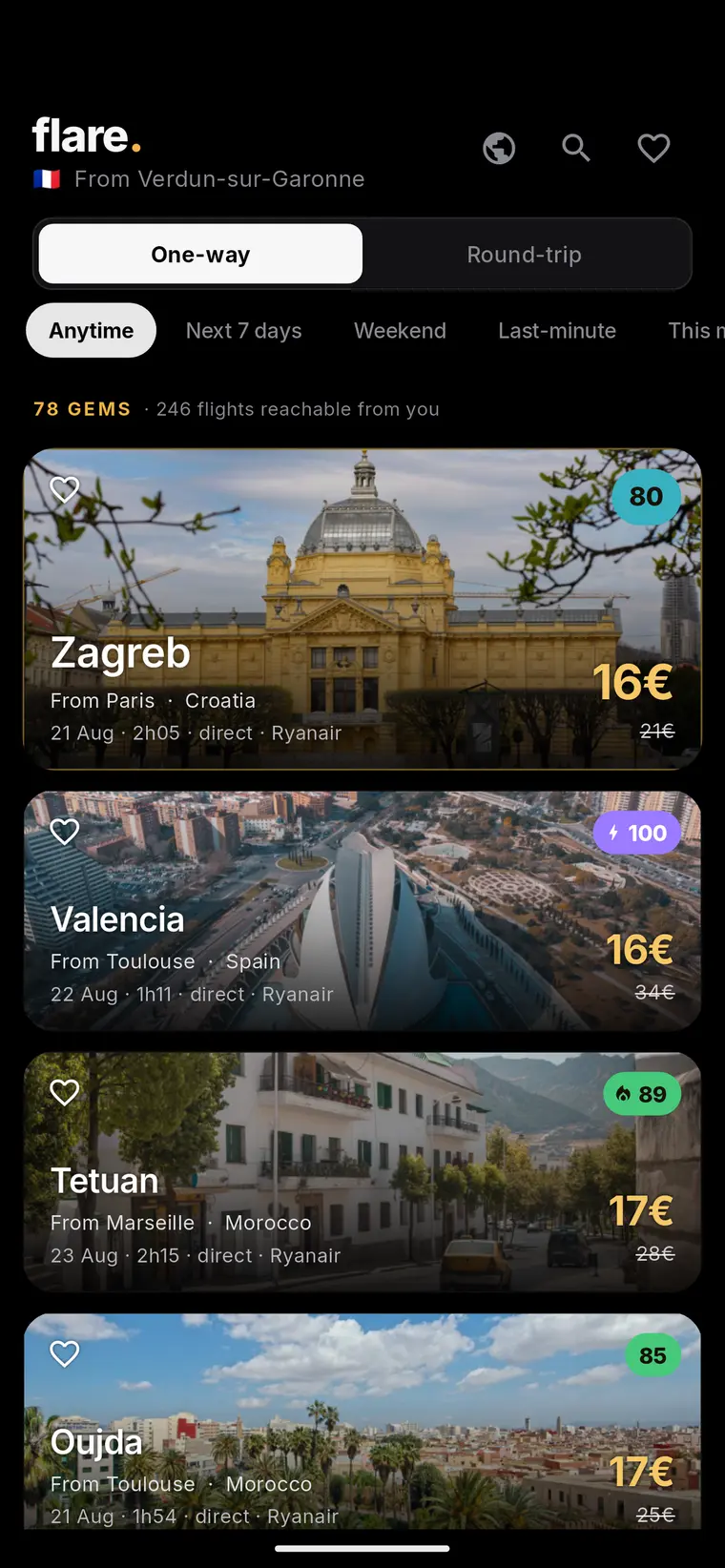
Deal discovery starts from the price. Instead of watching one route you picked, a discovery tool scans many and shows you the ones that stand out. Flare works this way: it publishes flight-deal pages organised by departure city, so a flexible traveller can see which destinations currently look cheap from home. The trade-off is clear. Tracking keeps you focused on a trip you already want; discovery can surface ideas you had not considered, but only you can judge whether the destination fits your time, budget and documents.
How a 'below reference' deal is measured, and what it cannot prove
When an alert says a fare is a deal, ask: compared with what? Flare's methodology page explains that its public pages only surface a fare when the measured drop is at least 30% against the reference price used by its monitoring. That reference is a Flare product measurement, not a universal market average or an airline-published price. Where there is enough route history, it is a median of observed baseline prices, calculated after trimming the outer 10% of observations, and a minimum history is required before a comparison is allowed. For some long-haul routes with limited history, the methodology describes a conservative distance-calibrated fallback reference with lower confidence. Flare also applies an internal Deal Score, which it describes as a prioritisation signal rather than an external rating, weighing the size and confidence of the drop alongside stops, duration and trip shape.
This tells you something real, within limits: where route history exists, the fare was unusual relative to that route's recorded prices; where a distance-calibrated fallback is used, the comparison is a rougher, lower-confidence signal. Either way, it does not tell you the fare is the lowest possible, that it includes luggage or seat choice, or that it will still exist when you click through. Flare's methodology states that its pages show timestamped observations, not a booking engine or a guarantee of availability. In practice, every price you see needs to be confirmed with the airline or booking provider, because fares and seats can change between the scan and your search.
Turning an alert into a total-trip comparison
A low headline fare can turn into an ordinary trip once you add what the fare leaves out. Flexible comparison means putting the alert next to at least one alternative: a different date, a nearby airport, or the same route on a fare you would actually buy. The aim is to compare whole trips, not sticker prices.
Before deciding, build a quick picture of the full journey. Long connections, early departures and distant airports carry costs in money, time and energy that an alert headline cannot show.
- Baggage: check what the fare includes and what checked or cabin bags would add.
- Ground transport: price getting to the departure airport and from the arrival airport at those times of day.
- Connections: check total travel time, layover length and whether separate tickets are involved.
- Change and refund rules: read the fare conditions so you know what happens if plans shift.
- Accommodation: check whether the cheap dates line up with reasonable places to stay.
Example: working through one alert step by step
Example (hypothetical, for illustration only): a traveller sees a return fare from their home city to a coastal destination shown at roughly a third below its reference price. They are flexible on dates but have one fixed week off. First, they open the booking provider and search the exact dates. The fare is still available, but only on a basic ticket without a checked bag.
Next, they add the bag, price the late-night airport transfer, and compare the result with a slightly pricier direct flight two days later. The direct option ends up close in total cost and saves an overnight connection. They also check the destination's official entry requirements for their nationality and find the passport validity rule is met. They choose the direct flight. The alert did its job, which was to point them at a good destination and window, even though the final booking was a different fare.
The lesson is not that alerts mislead. It is that the alert answers 'is this unusual?' while the traveller still has to answer 'is this right for me, all in?'
Current official checks before booking and before departure
Entry, passport, visa and health requirements are not set by any alert or deal page. They depend on your nationality, your destination, any transit countries and sometimes your reason for travel. Check the destination government's official sources, and your own government's travel guidance, before you pay, because a non-refundable fare to a place you cannot easily enter is no bargain.
Check again close to departure. Rules can be updated between booking and travel, and airlines can change schedules too. A short routine helps: confirm the booking details with the provider, recheck official entry information, and review the airline's current baggage and check-in rules a few days before you fly.
- Confirm the live price and fare conditions on the booking provider's site.
- Check passport validity and any visa or entry authorisation for each country on the route.
- Review official health or documentation requirements from government sources.
- Recheck all of the above shortly before departure.
Live destination map
Fare data meets travel intelligence
Move from a current fare signal to a photographed destination page, then use Flare guides to evaluate the complete trip.



Frequently asked questions
Does an airfare alert mean the price is guaranteed?
No. An airfare alert reports a price that was observed at a particular moment. Fares and seat availability can change at any time, so the price must be confirmed with the airline or booking provider before you pay.
What does it mean when a flight deal is described as below the reference price?
It means the fare was compared with a reference value calculated by the tool reporting the deal and came out noticeably lower. Flare's published methodology, for example, describes its reference as a product measurement, not a universal market average or an airline-published price. Where enough route history exists, it is a trimmed median of observed baseline prices; for some long-haul routes with limited history, a conservative distance-calibrated fallback with lower confidence is used. Flare only surfaces fares at least 30% below that reference. This signals an unusual fare, not one that includes bags or is the best overall trip.
What should I check before booking a flight found through a deal alert?
Confirm the live price and fare rules with the booking provider, add the cost of baggage and airport transfers, compare at least one alternative date or route, and check official passport, visa, entry and health requirements for your nationality and destination. Recheck entry rules and booking details again shortly before departure.
Sources and further reading
These resources provide the wider reference frame. Product statements on this page are limited to the public information provided by Flare.