


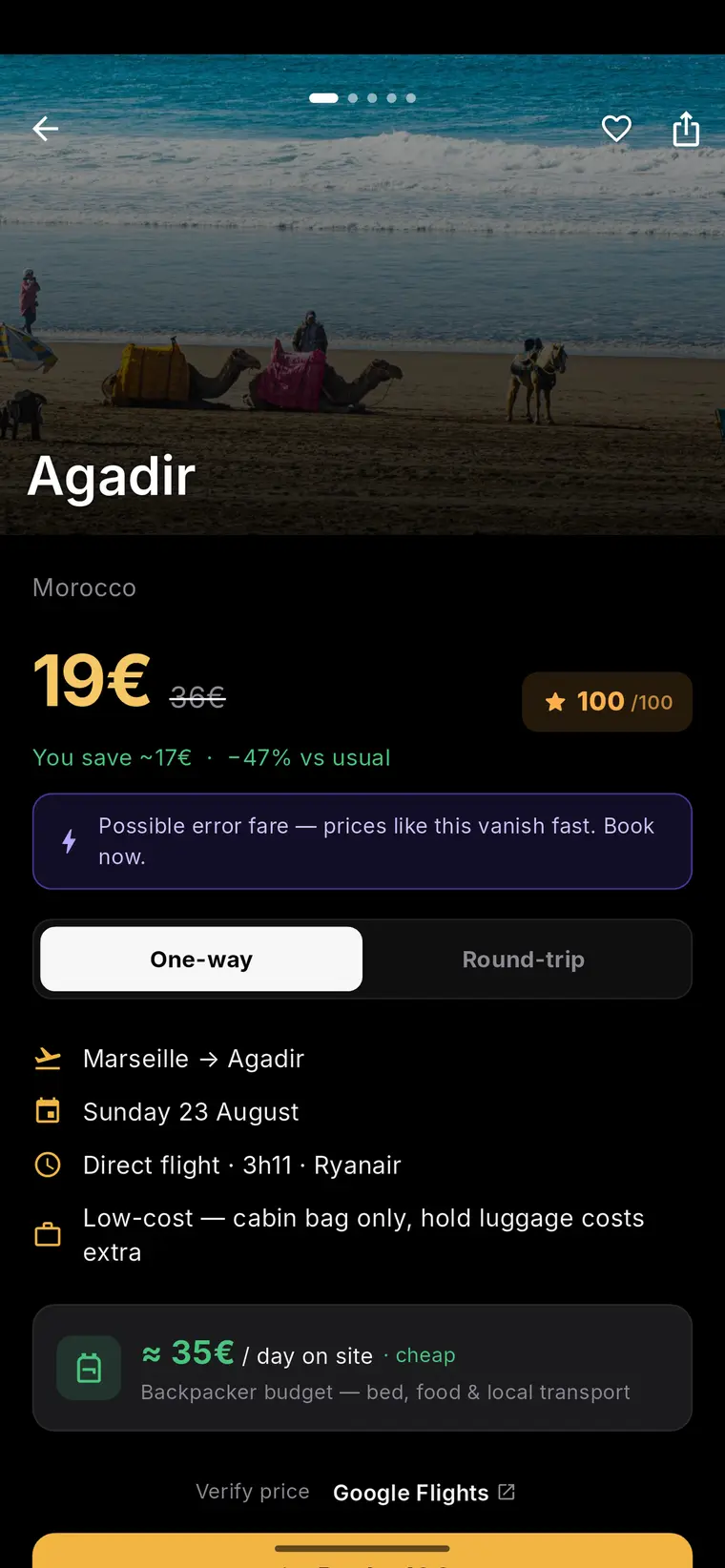

What an error fare detector actually does
An error fare detector is any tool or service that watches published airfares and flags prices that look far out of line with what a route normally costs. The aim is to catch fares that may come from a pricing or filing mistake, a currency glitch or an unusually aggressive sale, before they disappear. For a flexible traveller, that can turn a vague wish to go somewhere into a concrete, affordable option.
A detector does not prove that a fare is a mistake, though. It only shows that a price sits well below some reference point the tool uses. Whether the fare is an error, a deliberate promotion or a short-lived fluctuation is a separate question, and the answer changes what you should do next. Before acting on any alert, the useful habit is to ask two things: what the price is being compared against, and what still has to be confirmed before the trip is real.
Mistake fare or ordinary fare drop: why the label matters
Flare's guide to mistake fares versus fare drops separates two ideas that are easy to blur. A mistake fare is a price that was probably never meant to be sold. A price drop, as Flare uses the term, is narrower: it is only the amount by which a price sits below an internal reference the product uses. That calculation does not diagnose why the price exists or what the seller intended, so a measured drop says nothing on its own about whether the fare is a promotion, a routine fluctuation or a slip.
The guide also gives the two a different main risk. For a measured drop, the chief risk is that the price or availability has already changed by the time you check. For a mistake fare, the chief risk is that the ticket is cancelled or never issued once the seller corrects the error, and how that is handled depends on the seller's terms and the rules that apply where you bought. Because those rules vary, this article cannot tell you what you would be entitled to; read the booking provider's conditions and, if it matters, check the official consumer guidance for your situation.
The practical consequence is simple. Treat any unusually cheap fare as worth investigating, but avoid committing money you cannot recover, such as non-refundable hotels or connecting tickets, until the flight booking has been confirmed and has stayed confirmed.
Where Flare fits and what its alerts can tell you
Flare builds flight-deal discovery pages around the city a traveller flies from, which suits people who start with a departure point rather than a fixed destination. According to its published methodology, a deal only appears when its price is detected at least 30% under the reference price the monitoring uses for that route. That reference is usually a trimmed median of observed route history, though some long-haul routes with limited history rely instead on a conservative fallback calibrated by distance. The threshold explains why something was flagged; it does not label the fare as an error or promise that the price still exists.
In other words, Flare's role in this question is bounded. It can help you notice a fare that stands out against that reference. It cannot confirm the price you will finally pay, seat availability, or whether you meet the conditions to travel. Those answers come from the booking provider and from official sources, and they can change between the moment a deal is detected and the moment you look.
Judging the whole trip, not just the headline fare
A dramatic discount on the base fare can shrink once the full trip is costed. Checked bags, seat selection, separate positioning flights, airport transfers, late arrivals that force an extra night, and accommodation at the destination all belong in the comparison. A modest saving can disappear entirely if the cheap dates fall in a busy period at the other end.
Flexible comparison helps here. Instead of anchoring on one alert, compare it against a few alternatives: nearby dates, a neighbouring airport, or a different destination with similar appeal. If the flagged fare still wins after adding the real costs, it is a strong candidate. If it only wins on the headline number, it is probably not the bargain it seemed.
Entry conditions are part of the trip cost too. Passport validity, visas and health requirements depend on your nationality, your circumstances and where you are going, so check them with official government sources before booking and again before departure.
Example: working through an error fare detector alert
Example (hypothetical, for illustration only): a traveller sees an alert for a return flight from their home city to a long-haul destination at well under the reference price shown for the route, for dates three months away. The figures and scenario are invented to show the reasoning, not taken from any real deal.
First, they open the booking provider and confirm the fare, dates and baggage rules still match. Second, they add costs: a checked bag, a night near the airport because of an early departure, and a week of accommodation at the destination. Third, they check official entry requirements for their passport and find a visa application is needed, with its own fee and lead time. Finally, they decide to book the flight alone, wait for the confirmation and ticket number, and only then reserve refundable accommodation. If the airline later changes or cancels the booking, their exposure is limited to what they can recover under the provider's terms.
A short checklist before you act
Speed matters with unusual fares, but a few minutes of checking prevents most expensive surprises. The list below is designed to be run quickly, in order, the moment an alert catches your eye.
If any item fails, the alert has still been useful: it pointed you to a route or date worth watching, even if this particular fare is not the one to buy.
- Confirm the exact fare, dates, cabin and baggage allowance with the booking provider.
- Note what the price was compared against and whether the source calls it an error or simply a measured drop.
- Add bags, transfers, extra nights and destination costs to get a total-trip figure.
- Compare against at least two flexible alternatives: other dates, airports or destinations.
- Check passport, visa and health rules with official sources for your nationality.
- Read the provider's change and cancellation terms before paying.
- Hold off on non-refundable add-ons until the booking is confirmed and ticketed.
Live destination map
Fare data meets travel intelligence
Move from a current fare signal to a photographed destination page, then use Flare guides to evaluate the complete trip.



Frequently asked questions
Does an error fare detector guarantee that a fare is a real mistake?
No. An error fare detector flags prices that sit far below a reference level for a route, but a low price can have other causes, such as a sale or a short-lived fluctuation. Only the seller knows why a fare was priced that way, so treat any alert as a lead to verify rather than proof of an error.
Can an airline cancel a flight booked at an error fare?
It can happen with fares that appear to be pricing mistakes, and how it is handled depends on the seller's terms and the consumer rules that apply to your purchase. Read the booking provider's conditions before paying, check official consumer guidance if needed, and avoid non-refundable extras until the booking is confirmed.
What should I check before booking a very cheap flight I found through a deal alert?
Confirm the price, dates and baggage rules directly with the booking provider, since fares and seat availability can change quickly. Then add all trip costs such as bags, transfers and accommodation, and check current passport, visa and health requirements with official sources for your nationality and destination.
Sources and further reading
These resources provide the wider reference frame. Product statements on this page are limited to the public information provided by Flare.