


What a search for cheap flights non stop only is really asking
Searching for cheap flights non stop only usually means you have already made one decision: you will not trade a connection for a lower price. That rule is reasonable. A single flight segment means no transfer, no connecting airport and often a shorter day. But it narrows the field, so the useful question is not only how to find the lowest non-stop price but how to judge whether a given non-stop fare is good value for your whole trip.
Be precise about the word. Check the number of stops shown on each itinerary rather than trusting a label alone, because booking sites do not all use terms such as direct and non-stop in exactly the same way. If the itinerary shows zero stops and a single flight, it meets your rule. Anything else deserves a closer look before you count it as an option.
Why a non-stop rule changes how you compare fares
Once you rule out connections, flexibility becomes your main lever. On some routes only one or a few carriers may fly non-stop, and not necessarily every day. Widening your search to nearby departure airports, neighbouring dates or a different arrival city can do more for the price than waiting for one exact itinerary to fall.
Total-trip context matters too. A connecting fare that looks cheaper on screen can carry costs missing from the headline price: a meal at a hub, a possible overnight stay or longer travel time. If an option involves a self-transfer between separately bought tickets, check what happens if the first flight is late before treating it as comparable. Equally, a non-stop flight from an airport farther from home can lose its advantage once you add transport, parking or an early taxi. Compare the door-to-door picture, not only the fare line.
- Search a range of dates rather than one fixed day
- Include every airport you could realistically use at both ends
- Add baggage, seat and transfer costs before comparing totals
- Count travel time as a real cost, especially on short trips
How Flare fits a non-stop-only search, and its limits
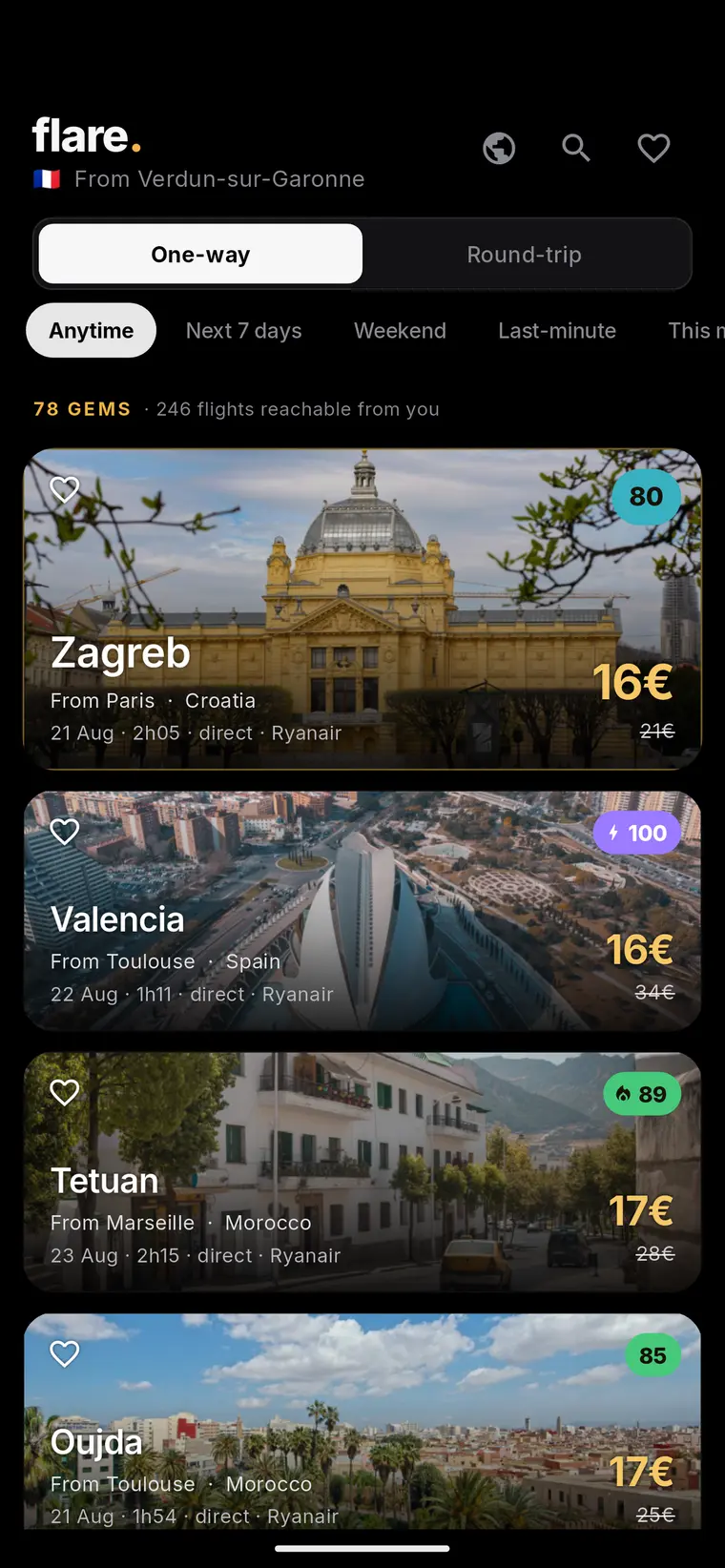
Flare publishes flight-deal discovery pages by departure city, and its methodology states that each fare card shows the stop count, the airport IATA codes, the dates and the trip type. For a non-stop-only traveller, that makes screening practical: discard any candidate that does not show zero stops, then confirm the full itinerary in a fresh search with the booking provider. Flare does not present this as a non-stop filter, so the screening is yours to do.
A fare appears only when it sits at least 30% below the reference price Flare uses for that route. Where enough route history exists, that reference is a median of observed prices with the outer 10% trimmed away. For some long-haul routes with limited history, Flare can instead use a more conservative, distance-calibrated fallback reference, which carries lower confidence. A Deal Score also weighs stops, duration and trip shape, but it is a prioritisation signal, not an outside rating, and a high score does not make a fare verified.
Each listing is a timestamped observation, so price or seats may already have changed. Flare's guidance on mistake fares adds that a very low price is not automatically a pricing error: a measured drop shows an amount, route and difference at one moment, not why the seller set it. Treat an implausibly low non-stop fare as a lead to verify, and avoid non-refundable extras until the ticket is issued.
Example: weighing a non-stop fare against a connection
Hypothetical example, for illustration only: you are comparing two return trips for the same week. Option A is non-stop at 240 in your currency, with a cabin bag included. Option B connects through a hub at 190, but the outbound layover is nine hours and checked baggage costs 35 each way. The figures are invented to show the method, not taken from any real route.
Add the visible extras first: Option B becomes 260 with both bag fees, already above Option A, before counting a hub meal or the lost day. Flip the scenario, with the non-stop at 400 and the connection at 190 including luggage, and the choice becomes a genuine trade-off between price and time that only you can value. The point is to run the same arithmetic every time instead of reacting to the headline number.
- Step 1: confirm stops and flight numbers on each option
- Step 2: add baggage, seats and airport transfer costs
- Step 3: note total travel time and any overnight layover
- Step 4: decide what an hour of your time is worth on this trip
- Step 5: repeat the exact search before paying
A pre-booking checklist for non-stop deals
When you have a non-stop fare you like, slow down. Repeat the exact search with the booking provider, because the price seen on a discovery page may not be the price offered now. Read the fare conditions: change rules, refunds and baggage allowance vary by fare type, and the cheapest non-stop fare can be the most restrictive.
Then look beyond the ticket. Passport validity, visas, entry rules and health requirements depend on your situation and destination, and they can change. Check current official government sources before you book and again before you travel.
- Price and seats reconfirmed with the airline or agency
- Zero stops shown on every segment of the itinerary
- Baggage allowance matches what you plan to carry
- Change and refund rules understood
- Passport, visa and health requirements checked with official sources
- No non-refundable hotels or extras booked before the ticket is issued
Live destination map
Fare data meets travel intelligence
Move from a current fare signal to a photographed destination page, then use Flare guides to evaluate the complete trip.



Frequently asked questions
Are non-stop flights always more expensive than connecting flights?
Not necessarily. A non-stop fare can be higher than a connecting one on some routes, but once you add baggage fees, meals, long layovers or extra travel time, a connecting itinerary can end up costing as much or more. Compare the total cost and travel time of each option rather than the headline price alone.
How can I find cheaper non-stop flights without accepting connections?
Use flexibility instead of stops as your lever: search a range of dates, include every airport you could realistically use at both ends, and compare total trip cost including baggage and ground transport. Whatever price you find, repeat the exact search with the booking provider before paying, because fares and availability change.
Does a large price drop mean a non-stop fare is a mistake fare?
No. A large difference from a reference price shows that a fare was unusually low when it was observed, but it does not prove the seller published it by error. Only the airline, the agency or a reliable confirmation can establish that. If a fare seems implausibly low, wait for the ticket to be issued before committing to non-refundable plans.
Sources and further reading
These resources provide the wider reference frame. Product statements on this page are limited to the public information provided by Flare.