


What a search for cheap airlines cheap is really asking
Someone typing cheap airlines cheap usually wants one thing: the lowest realistic price for getting from home to somewhere else. The phrasing points to airlines, but in practice cheapness belongs to a specific fare, on a specific route, at a specific moment. The same carrier can look like a bargain on one date and expensive on the next, so the most useful habit is to compare fares and conditions rather than to rely on a list of airlines with a cheap reputation.
That shift matters because a reputation cannot tell you what you will pay next Tuesday. A fare you can see, with its date, route and conditions, can. Flexible travellers have an advantage here: if you can move your dates, your destination or your departure airport, you widen the pool of fares to compare and improve your odds of finding a genuinely low one.
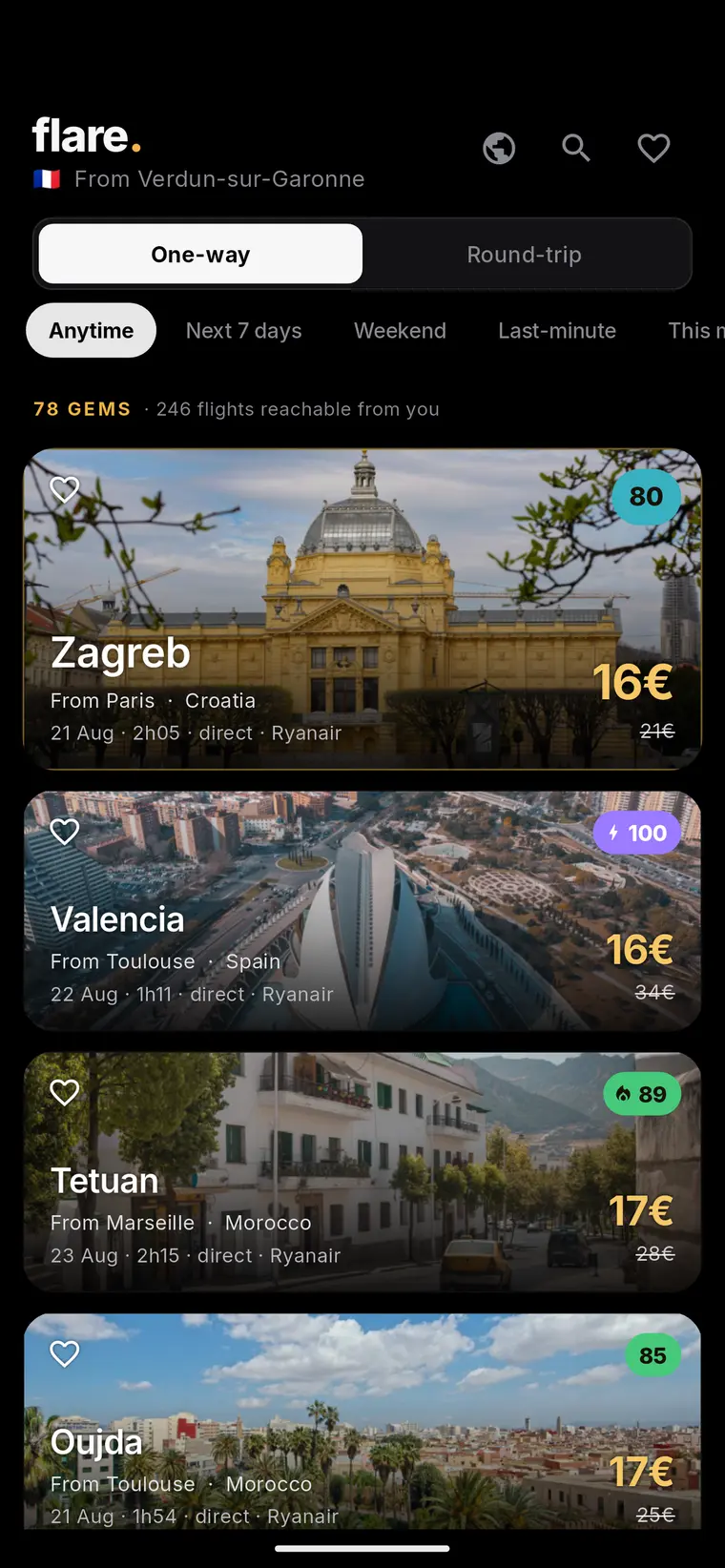
Flare, a fare-discovery service that publishes deal pages organised around where a traveller departs from, works within the same limit. It observes prices and highlights unusual drops; it does not sell tickets or rank airlines. The guidance below follows that boundary: it helps you judge a low price, not promise one.
Why a low headline fare is not the same as a cheap trip
The number shown in a search result is a starting point. What you actually spend depends on what the ticket includes and what the journey around it costs. Two fares that look similar can end up far apart once you add the things you personally need, so the honest comparison is total trip cost, not ticket price.
Before treating any fare as cheap, list your own requirements and check each one against the fare conditions on the booking page. The answers vary by seller and fare type and can change, so read them for the exact ticket rather than assuming.
- Luggage: what is included, and what would you pay to add the bags you will really carry?
- Seats and travelling together: does sitting next to companions cost extra?
- Airports: how far is each airport from where you start and where you are going, and what does that transfer cost in money and time?
- Timing: does an early departure or late arrival force an extra night of accommodation?
- Changes: what happens to the money if your plans move?
How to read a measured price drop without overreading it
Flare's methodology page explains how a fare earns a place on its public pages. A candidate needs a positive current price and a positive comparison reference, a measured drop of at least 30% against that reference, and a Deal Score of at least 55. Where enough route history exists, the reference is a median of previously observed baseline prices, calculated after trimming the outer 10% of observations so that a few extreme values do not distort it. Some long-haul routes may instead use a conservative fallback reference.
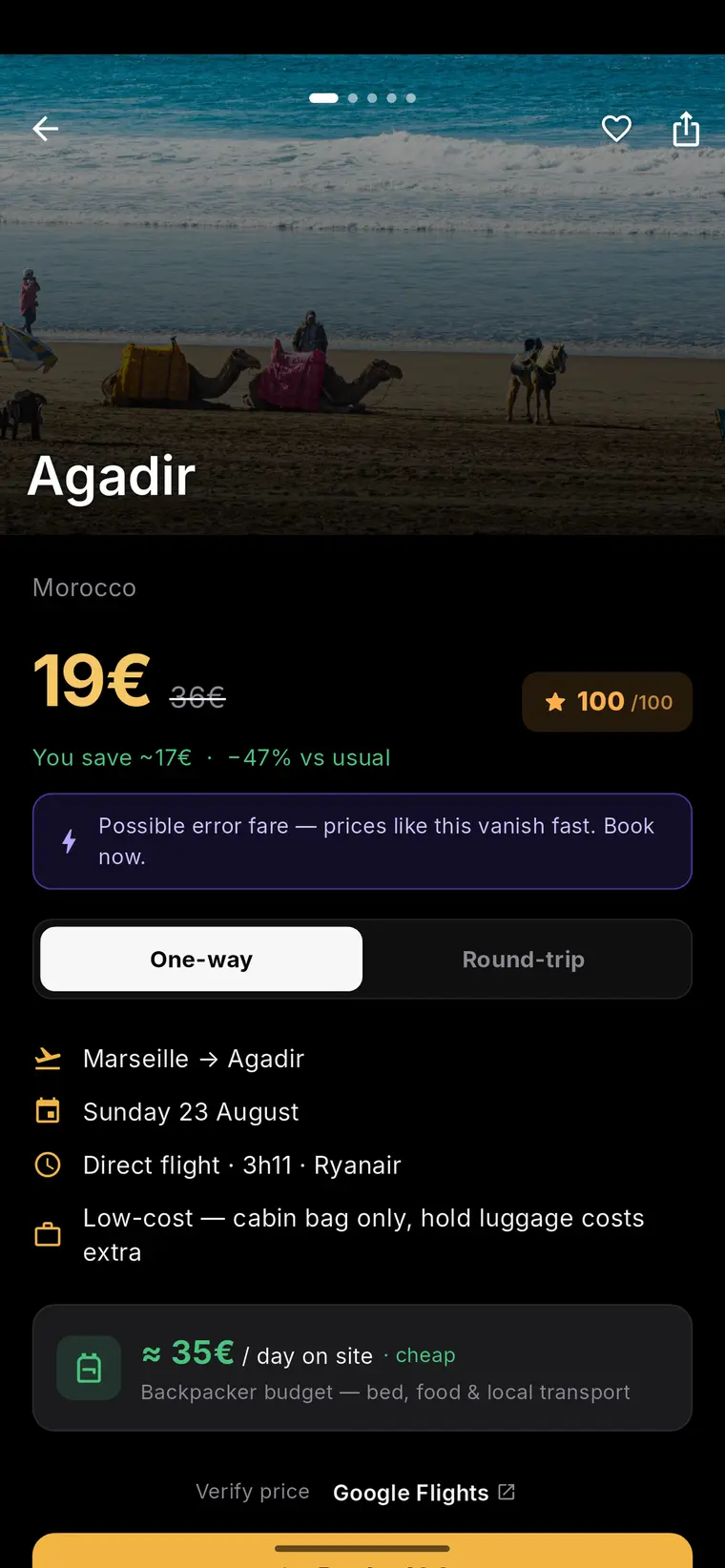
The practical reading is narrower than it might appear. A 30% drop means the fare sat well below what that route has typically shown in the data, at the moment of observation. It does not mean the fare is the lowest available anywhere, and it does not describe the total trip cost covered in the previous section. The Deal Score is a way to prioritise candidates, weighing the size and confidence of the drop with features such as stops, duration and trip shape. It is not an independent rating, and a high score does not make a fare verified.
Each figure is also a timestamped snapshot. By the time you open a booking page, the price or seat may have gone. Treat any surfaced deal as a lead worth repeating in a live search, not as a quote.
Unusually cheap: mistake fares versus ordinary drops
Very low prices tempt people to call them mistake fares, but Flare's guide on the subject draws a careful line. A mistake fare describes a seller publishing a price it did not intend, for example through human error, a technical fault, currency conversion or missing charges. That is about the seller's intent, which a price observation alone cannot reveal. Flare can show an amount, a route, a time and the gap from its reference; it cannot prove why the price exists unless the seller or a reliable source confirms it.
The risks differ too. With an ordinary drop, the main danger is that the price changes before you book. With a genuine error, the ticket may later be cancelled or never issued, and airlines do not honour such fares automatically. If a price looks implausibly low, a cautious approach is to avoid committing to non-refundable hotels, tours or connecting transport until the ticket is confirmed.
Worked example: comparing two cheap-looking options
Example only, with invented figures for illustration. A traveller sees Option A at 60 for a one-way flight from a secondary airport, and Option B at 85 from their nearest airport. Option A excludes a cabin bag the traveller needs, which they estimate would add 35, and the airport transfer costs 25 more than reaching the nearer airport. The 6am departure also means a night near the airport at around 50.
Adding it up, Option A comes to roughly 170 against Option B's 85 plus whatever extras it needs. If Option B already includes the bag, it is the cheaper trip despite the higher headline. The lesson is not that one type of airline wins; it is that the comparison only becomes meaningful once each option carries the same requirements.
A short decision aid follows from this: write your must-haves first, price both options against that same list, then ask whether the gap justifies the inconvenience. If the gap is small, choose the fare with clearer conditions and easier logistics.
Checks to make before booking and before departure
Even the best fare comparison is only as good as the final confirmation. Prices and seat availability can shift between a discovery page and checkout, so the figure that counts is the one the booking provider shows you at the moment you pay. Confirm the total, the included items and the change rules on that page.
Travel documents are a separate check that no fare page can make for you. Whether you need a particular passport validity, a visa or any health documentation depends on your nationality, your circumstances and your destination, and the rules can change. Look at current official government sources before you book, and again shortly before you leave.
- Repeat the exact search on the seller's site and confirm the live price.
- Read baggage, seat and change conditions for that specific fare.
- Add transfers, timing costs and extras to reach a total trip figure.
- Hold off on non-refundable add-ons if the price looks like a possible error.
- Check official entry, passport, visa and health requirements for your situation.
Live destination map
Fare data meets travel intelligence
Move from a current fare signal to a photographed destination page, then use Flare guides to evaluate the complete trip.



Frequently asked questions
Are low-cost airlines always the cheapest way to fly?
Not necessarily. A carrier's cheap reputation does not tell you what a specific trip will cost. The total depends on the fare on your chosen date and route, what that fare includes, and costs around the flight such as luggage, airport transfers and awkward timings. Comparing the full trip cost for each option, using your own requirements, is a more reliable test than the brand name.
Does a high Flare Deal Score mean a fare is guaranteed or verified?
No. Flare's Deal Score is an internal prioritisation signal that weighs the size and confidence of a price drop alongside itinerary features such as stops and duration. It is not an external rating and does not verify a fare. Flare's figures are timestamped observations, so the price and availability must be confirmed with the booking provider before purchase.
Will an airline honour a mistake fare if I book one?
Sometimes, but never automatically. A mistake fare is a price a seller did not intend to publish, and the airline or travel agency may cancel or decline to issue the ticket after correcting it. Because a low price alone cannot prove an error, it is sensible to wait for ticket confirmation before paying for non-refundable accommodation or other travel arrangements.
Sources and further reading
These resources provide the wider reference frame. Product statements on this page are limited to the public information provided by Flare.