


What international flight sales alerts actually tell you
International flight sales alerts are notifications that a fare on a route abroad has moved in a way worth your attention. They do not mean an airline has announced a sale. They mean a system compared a current price against something else, such as an earlier price, a typical price, or a price history, and decided the gap was large enough to report.
That distinction shapes how you should act on one. An alert is a prompt to look, not a confirmed offer. The fare it describes was observed at a point in time, and international fares can change or sell out between the moment an alert is generated and the moment you open the booking page. Treat every alert as a lead you still need to verify with the airline or booking provider.
The useful question is therefore not only how cheap the fare is but compared with what, observed when, and for which exact itinerary. The answers depend on the type of alert you have set up.
Tracked routes versus discovered deals
Broadly, international flight sales alerts come in two forms. The first is tracking a route you have already chosen. Google's Travel Help page describes this for Google Flights: you pick an origin, destination, cabin and number of tickets, turn on price tracking for set dates or for any dates, and receive email updates when prices change significantly. According to that page, tracking any dates sends an email when the route's lowest price drops significantly over a month, and otherwise a regular email with the best available prices. It also describes notices when prices are likely to rise or a current fare is expected to expire soon. Those features may change, so check the help page itself.
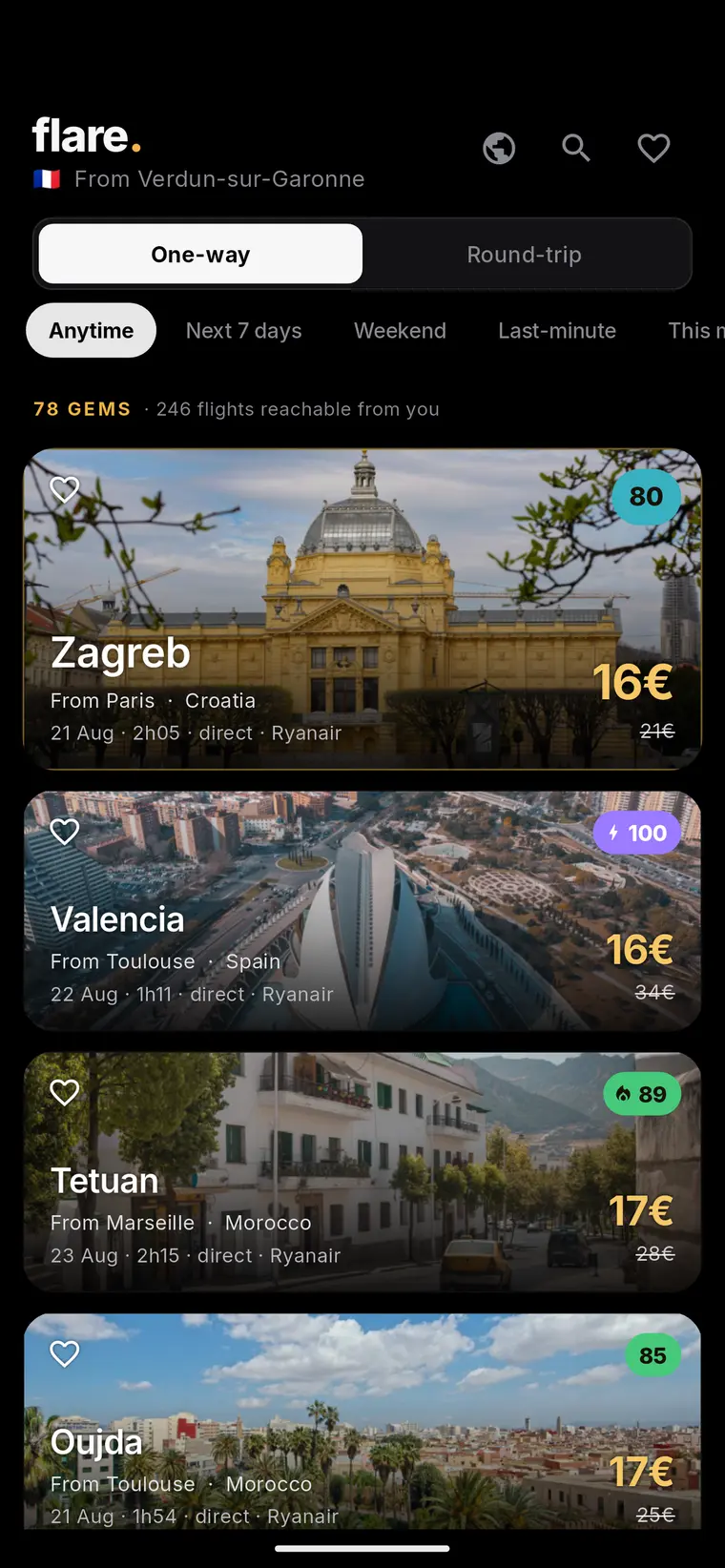
The second form is discovery: instead of watching one route, a service scans many destinations and surfaces the unusually low ones. Flare works this way, publishing deal pages organised by the city you fly from. Its methodology page states that a fare only appears there when it sits at least 30% below the reference price its monitoring uses for that route, and that the pages are timestamped observations rather than bookings or quotes.
Route tracking suits travellers who already know where they want to go. Discovery suits flexible travellers who will pick a destination because the price is right. Many people use both: discovery to generate ideas, tracking to watch a shortlisted route.
What the sale in a sale alert is measured against
A percentage drop is only as meaningful as its baseline. Flare's methodology explains that, where enough route history exists, its comparison value is a median of observed baseline prices, with the outer 10% of observations trimmed first and a minimum amount of history required. That approach is designed to stop one unusually expensive or cheap observation from inflating the apparent saving, but it is still Flare's own reference, not an official or market-wide price.
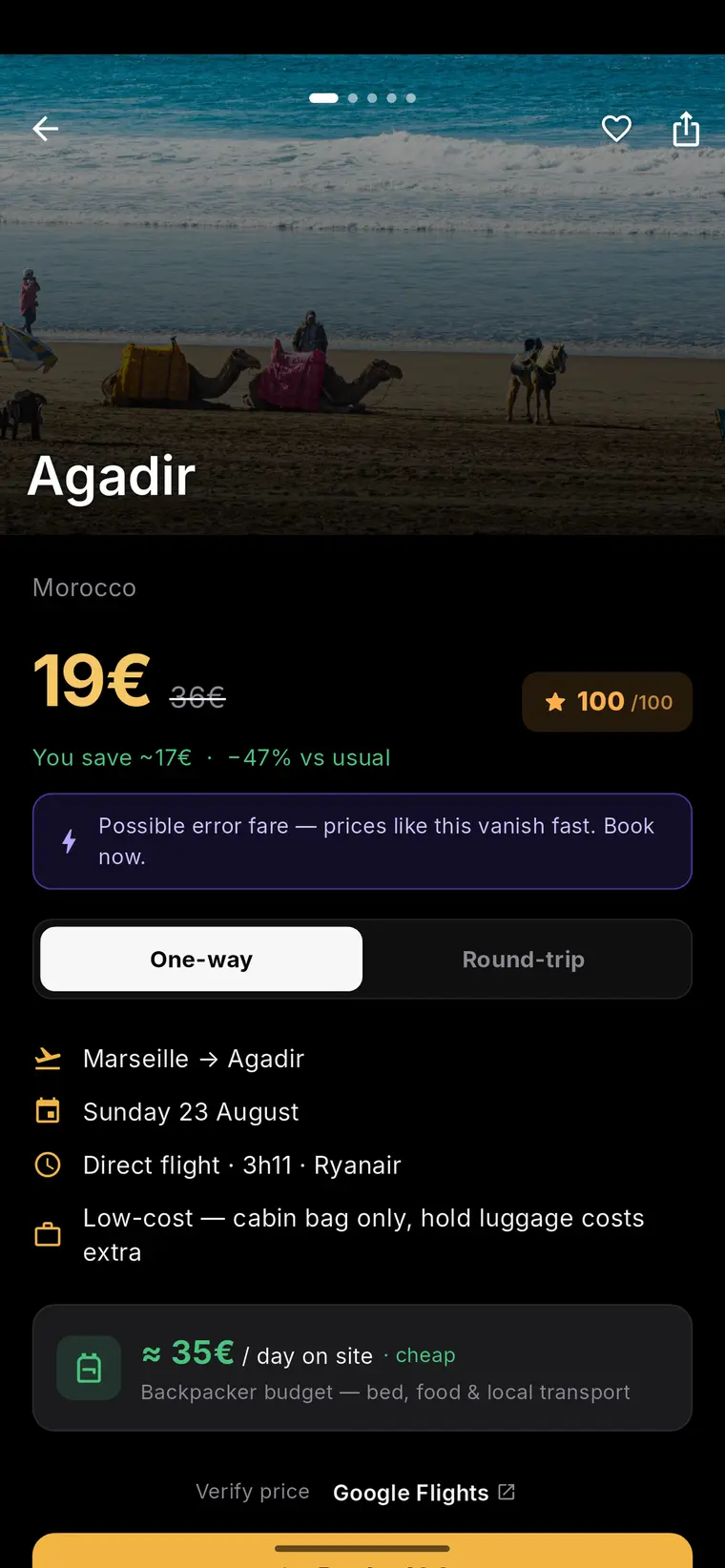
The same page describes a Deal Score used to rank candidates, weighing the size and confidence of the drop alongside stops, duration and trip shape. It states plainly that the score is a prioritisation signal, not an external rating, and that a high score does not make a fare verified. Keep that in mind whenever any service attaches a score or badge to an international deal.
In practice, a large percentage on a long-haul route may come with trade-offs that the headline hides: extra connections, long layovers, awkward departure times or a restrictive fare type. The saving is real only if the itinerary still works for you.
Put the fare in total-trip context
International trips carry more costs beyond the ticket than domestic ones. A low fare to a distant airport can be offset by baggage fees, seat charges, an expensive transfer into the city, an overnight connection that needs a hotel, or dates that land in a costly accommodation period at the destination.
Before reacting to an alert, price the whole journey roughly. Add the realistic cost of bags for your trip length, getting to and from both airports, and accommodation for the specific nights. Compare that total, not the fare alone, against a more convenient alternative.
Timing matters too. Separate tickets on international connections can leave you exposed if a first flight is delayed, and long layovers may involve transit rules at the connecting country. Confirm what the fare includes and how the itinerary is ticketed before committing.
Current official checks before booking international flights
No price alert can tell you whether you are allowed to travel. Entry, passport, visa and health rules vary with your nationality, your destination and sometimes your connecting points, and they can change. A fare that looks ideal is useless if you cannot obtain the documents in time.
Check the current official requirements for your destination and any transit country before booking, then again before departure. Look at passport validity rules, visa or electronic authorisation needs, and any health-related entry conditions published by official government sources. This article does not give legal or medical advice; official sources and the relevant authorities are the reference.
A decision checklist for acting on an alert
Flexible travellers get the most from international flight sales alerts when they have decided in advance what a good enough deal looks like. The checklist below keeps the decision fast without skipping the checks that matter.
Example, hypothetical: you receive an alert for a return fare to a European city that is 40% under the usual reference. You open the booking provider and find the price still available, but it involves a nine-hour overnight connection and excludes checked bags. Adding a bag each way, an airport hotel and a late train raises the total close to a direct fare you had seen earlier. In this example the alert was accurate yet not the better trip, and the checklist would have shown that within minutes.
- Confirm the fare, dates and availability directly with the booking provider; the alert is only a snapshot.
- Check how the saving is measured and against which reference price.
- Review stops, layover length, airports and arrival times.
- Estimate bags, seats, transfers and accommodation for the full trip.
- Read the fare conditions for changes, cancellations and refunds.
- Verify current official entry, passport, visa and health requirements for your destination and any transit points.
- Compare the total with at least one more convenient alternative before paying.
Live destination map
Fare data meets travel intelligence
Move from a current fare signal to a photographed destination page, then use Flare guides to evaluate the complete trip.



Frequently asked questions
Are international flight sales alerts the same as airline sales?
Not necessarily. Most international flight sales alerts report that a monitored fare has dropped against a reference price or earlier observation. The airline may not be running a promotion at all. Always confirm the current fare and availability with the airline or booking provider before booking.
Why was the price different when I clicked a flight deal alert?
Flight deal alerts reflect a price observed at a specific time, and international fares can change or sell out quickly as seats are booked and fare classes close. A different price on the booking page is common. The booking provider's current price is the one that applies.
What should I check before booking a cheap international flight from an alert?
Confirm the live fare and fare conditions with the booking provider, review stops and layovers, estimate the full trip cost including bags, transfers and accommodation, and verify current official entry, passport, visa and health requirements for your destination and any transit country.
Sources and further reading
These resources provide the wider reference frame. Product statements on this page are limited to the public information provided by Flare.