


What it means to review a flight price before acting
To review a flight price is to ask two questions before paying: is this number good relative to what the route usually costs, and is it still the real number for the trip you would actually take? A fare can look cheap on a results page and still be a poor choice once dates, baggage, transfers and travel documents are counted. A careful review separates the headline figure from the decision.
For flexible travellers, the review is less about finding a single perfect price and more about building enough context to act calmly. That means comparing across dates and departure points, understanding what any 'deal' label is measured against, adding the costs the fare does not show, and confirming everything with the booking provider and official sources. The sections below walk through each step and end with a worked example and a checklist.
Compare flexibly instead of fixing on one search
A single search captures one moment for one combination of dates and airports. Prices on the same route can move between searches, so a review becomes more useful when you look at a range. Shifting departure by a few days, considering a nearby airport, or accepting one stop instead of a nonstop can change the picture more than waiting for a single itinerary to drop.
Tracking tools help here. Google's Travel Help page, at the time of reading, describes turning on price tracking in Google Flights for a specific flight, for a route on searched dates, or for a route on 'Any dates' when your dates are flexible, with email updates when prices change significantly. It also describes notifications when prices on a tracked route are likely to rise or when a current fare is expected to expire soon. Features like these can change, so treat them as a convenience for watching a route, not a promise about future fares.
Flexibility also guards against a common trap: anchoring on the first price you saw. If you only remember one number, every later price feels like a loss or a gain against it, even though that first figure may have been unusually high or low.
How to read a deal label against a reference price
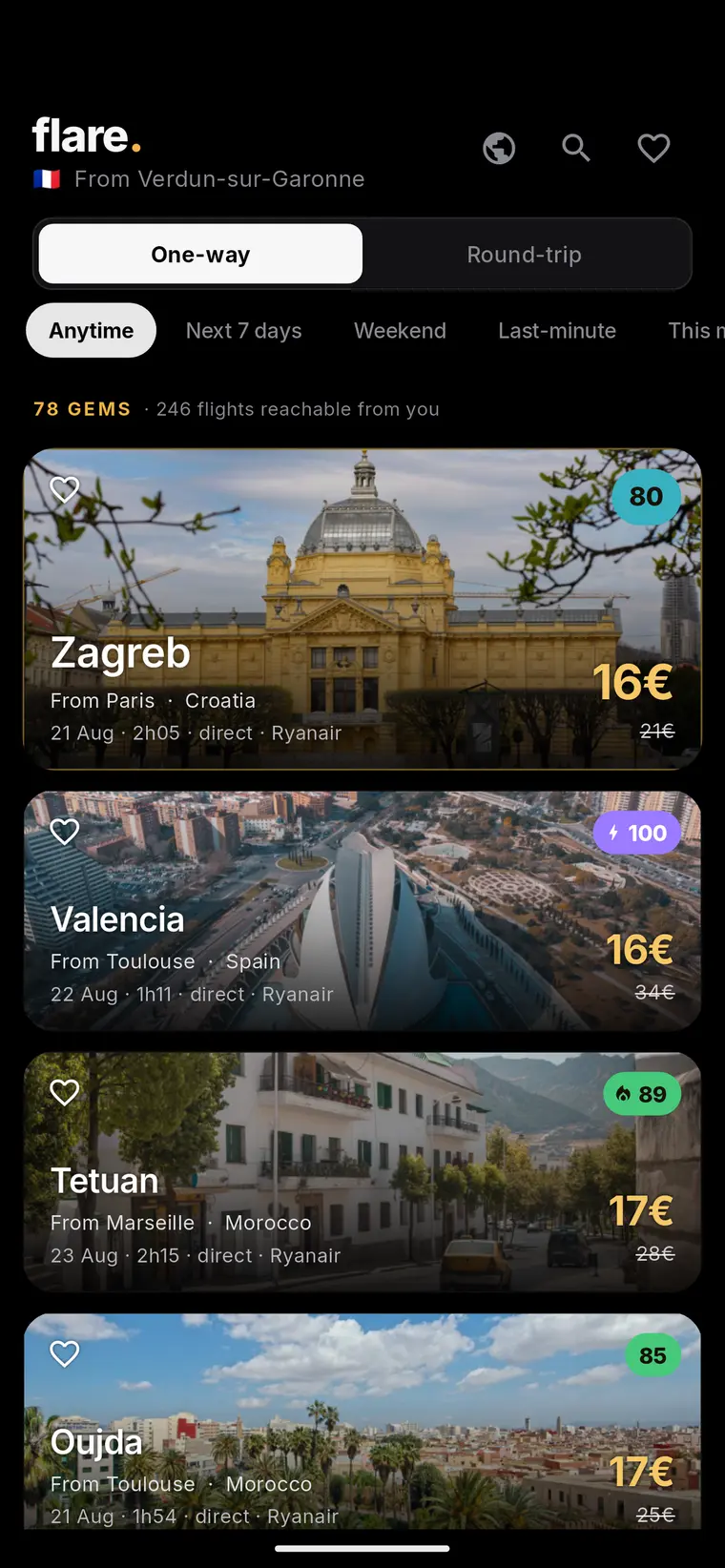
Many discovery tools describe a fare as a deal because it sits below some comparison value. The useful question is what that comparison value is. Flare, which publishes flight-deal discovery pages organised around a traveller's departure city, explains in its methodology that a fare is only surfaced when it measures at least 30% under the reference price its monitoring uses for that route. Where enough route history exists, that reference is based on a median of observed baseline prices after trimming the outer 10% of observations; the methodology ties that history-based comparison to a minimum amount of data, so not every route's reference rests on the same depth of history.
That context bounds what a deal label can tell you. It says the fare measured well below the reference Flare's own monitoring used for that route at the time of the scan. That reference belongs to Flare's measurement process, so the 30% figure describes a gap against Flare's comparison value rather than against a price an airline publishes or an average of the whole market. The label does not say the seat is still available, that the fare suits your dates, or that the total trip is cheap. Flare's methodology also describes its Deal Score as a prioritisation signal rather than an external rating, and states that its public pages are timestamped observations, not a booking engine or a quote. Read any deal label, from any source, as a reason to look closer rather than a reason to skip the review.
Total-trip context: what the headline fare leaves out
The fare is one line in a larger budget. A low ticket into an airport far from where you are staying, or a schedule that forces an extra hotel night, can cost more overall than a pricier flight with better timing. Reviewing a flight price properly means comparing whole trips, not isolated numbers.
Before deciding, list the costs and constraints that sit around the ticket. Not every item applies to every trip, but each can quietly change which option is actually cheaper or more workable.
- Baggage and seat selection, if the fare does not include what you need
- Ground transport to and from both airports, including late arrivals
- Extra accommodation caused by early departures or long connections
- Separate tickets that would not protect you if one leg is delayed
- Return-date fit with work, school or other fixed commitments
- Entry, passport, visa and health requirements, which vary by traveller and destination
Example: reviewing a flight price step by step
Hypothetical example, for illustration only: a traveller sees a return fare to a European city that a discovery page flags as well below the route's usual level. Rather than booking immediately, they open a flexible search for the same route across the surrounding week and a nearby departure airport. The flagged dates remain among the lower options, which suggests the label reflects something real rather than a one-off glitch.
Next, they price the whole trip. The cheapest itinerary lands after midnight, so they add a taxi and check whether their accommodation allows late check-in. They compare it with a slightly more expensive daytime flight and find the gap narrows once baggage and transport are included. They then go to the booking provider, confirm the final price and conditions on the checkout page, and check the destination's official entry requirements for their own nationality and passport before paying. The example numbers are not given because the method, not any specific price, is the point.
The checklist below condenses that process into a quick decision aid you can reuse for any route.
- Compare at least a few nearby dates and, if practical, another departure airport
- Ask what any deal label is compared against and when the price was observed
- Add baggage, transport and accommodation to get a total-trip figure
- Confirm the final fare, availability and conditions with the booking provider
- Check current official entry and travel-document requirements for your situation
- Set a personal ceiling in advance so you can decide without second-guessing
Limits that apply before you book
Every price you review is a snapshot. Fares and seat availability can change between the moment a page was generated and the moment you reach checkout, which is why the booking provider's final screen is the figure that counts. Discovery pages, tracking alerts and deal scores help you notice opportunities; they do not lock in a price.
Requirements around entry, passports, visas and health also depend on who is travelling and where. No flight comparison can answer those for you, so check current official sources before booking and again before departure, since rules can be updated. Taken together, a calm review combines flexible comparison, total-trip thinking, clear fare caveats and current official checks, and that combination usually matters more than finding the lowest number on a single screen.
Live destination map
Fare data meets travel intelligence
Move from a current fare signal to a photographed destination page, then use Flare guides to evaluate the complete trip.



Frequently asked questions
How can I tell if a flight price is actually good?
Compare it against a range of nearby dates and airports rather than a single search, and if a tool labels it a deal, find out what reference price it is measured against. Then add baggage, transport and accommodation costs, because a low fare is only good if the total trip still works for you.
Does a flight deal alert mean the price is guaranteed?
No. Deal alerts and discovery pages reflect prices observed at a particular time, and fares and seat availability can change before you book. Always confirm the final price and fare conditions on the booking provider's checkout page before paying.
What should I check besides the fare before booking a flight?
Check baggage allowances, transfer times, ground transport at both ends, and whether the schedule adds extra accommodation costs. Also verify current official entry, passport, visa and health requirements for your nationality and destination, as these differ between travellers and can change.
Sources and further reading
These resources provide the wider reference frame. Product statements on this page are limited to the public information provided by Flare.