


When to book flights last minute: the honest short answer
If you are asking when to book flights last minute, the most useful answer is that there is no single reliable day or hour. Prices close to departure are uncertain: on some routes and dates they may be lower than earlier in the booking window, and on others they may be higher. No pattern holds for every route, season or departure city, so any rule promising a fixed booking window deserves suspicion.
A better question is when a last-minute booking makes sense for you. That depends on how flexible your dates and destination are, how much of the trip is already arranged, and whether you can complete any official requirements in the time left. Travellers with open plans can treat a late fare as an opportunity worth examining. Travellers with fixed dates usually carry more risk by waiting.
Why a late price is a signal, not a rule
A low fare close to departure tells you something about that search at that moment. It does not tell you that waiting is generally cheaper, or that the same price will be there tomorrow. Fares and seat availability move, and the figure you see on a discovery page is only confirmed when the booking provider shows it to you at checkout.
It also helps to be precise about what a measured price drop means. Flare's guide on mistake fares versus fare drops explains that a price drop, in Flare's sense, is simply an amount below an internal reference price for the route. The calculation does not diagnose why the price exists, and Flare does not know the seller's pricing intent. A low figure could reflect a promotion, a different trip shape, another airport, currency effects or limited remaining inventory.
For a last-minute plan, the practical consequence is straightforward. The main risk is that the price or availability has already changed by the time you look. The useful response is to repeat the exact search, with the same dates, airports and passenger details, on the booking provider's site before you rely on the fare.
Freshness limits matter more when time is short
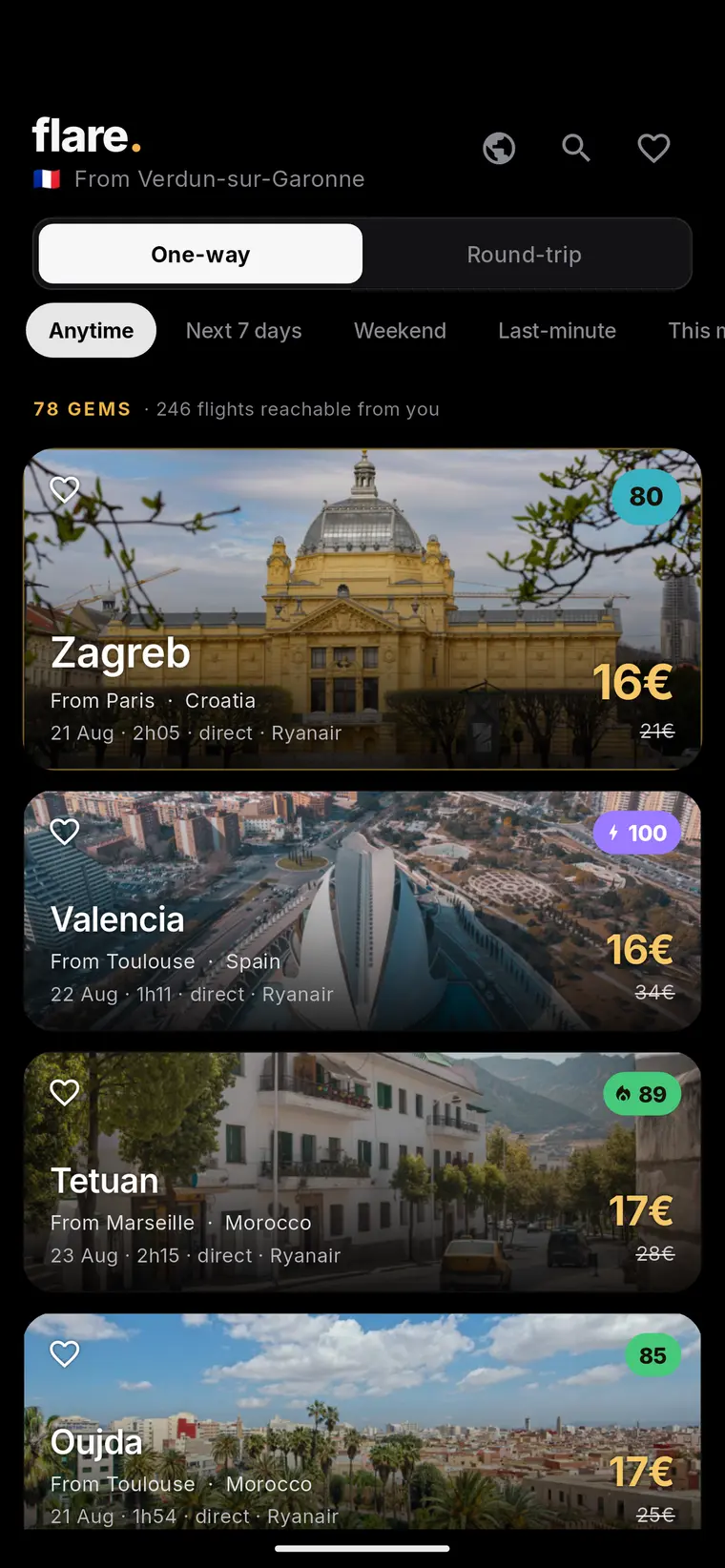
Late booking compresses everything, including the gap between when a deal was found and when you act on it. Flare's public deal collection is rebuilt on a schedule of roughly every three hours, and each page shows its own snapshot time in UTC. Reading that timestamp tells you how old the information is before you start planning around it.
A result can disappear between the page refresh and your own search. For a departure in a few days, a few hours can be the difference between an available seat and none. Treat any surfaced fare as a lead to check immediately rather than a reservation, and avoid committing to non-refundable accommodation or transfers until the flight itself is booked.
Look at the whole trip, not just the ticket
Last-minute savings on the flight can disappear in the rest of the trip. Accommodation near popular dates may be scarce, transfers from a secondary airport may add time and cost, and baggage or seat fees can change the comparison between two fares that looked similar. Comparing flexibly means putting these items side by side before you commit.
Time matters too. A cheap departure at an awkward hour may require an extra night somewhere, or leave you without a sensible way to reach the airport. Counting these costs gives you a total-trip figure, which is the number worth comparing with the alternative of booking earlier or choosing a different destination.
- Fare including bags and any seat fees you actually need
- Getting to and from both airports at the scheduled times
- Accommodation availability and price for the exact nights
- Return options if the outbound is cheap but the return is not
- Cost of changing or cancelling under the fare rules
Example: official checks and a late fare in practice
The tightest constraint on late booking is often paperwork rather than price. Passport validity, visas, electronic travel authorisations and health-related entry conditions vary with your nationality, your destination and sometimes your route, and some take time to obtain. Check current official sources before you pay and again before departure. Nothing here is legal or medical advice.
Hypothetical example, not based on real data: a traveller with a free long weekend notices a low return fare from their home city leaving in four days. The page snapshot is two hours old, so they repeat the exact search with the booking provider and find the fare still available with a small baggage charge added. Accommodation costs more than usual, and the return lands after public transport stops. They check the destination's official entry rules and learn no advance authorisation is needed for them. Adding a taxi and the higher hotel rate, the total still beats their earlier plan, so they book. Had an authorisation been required with uncertain processing time, the sensible choice would have been to pass.
- Can I meet every official entry requirement before departure?
- Have I repeated the exact search and confirmed the fare and bags with the provider?
- Does the total trip cost still beat my alternatives?
- Can I accept the change and cancellation rules?
How Flare fits, and where its limits are
Flare publishes flight-deal discovery pages built around your departure city. Its methodology describes surfacing a deal only when the fare is at least 30% under the reference price its monitoring uses for that route, so the pages help you spot unusually low prices rather than forecast when to book.
That boundary matters for last-minute planning. A surfaced deal can prompt a flexible comparison, but it reflects a dated snapshot, its cause is unknown, and the fare or seats may change before you book. Confirming the price, weighing total cost and meeting official requirements remain steps you complete with the booking provider and the relevant authorities.
Live destination map
Fare data meets travel intelligence
Move from a current fare signal to a photographed destination page, then use Flare guides to evaluate the complete trip.



Frequently asked questions
Is it cheaper to book flights at the last minute?
Not reliably. Prices close to departure can be lower or higher than earlier fares, and the outcome varies by route, date and season. Booking late suits flexible travellers who can compare several options and walk away if the numbers do not work; travellers with fixed dates usually take more risk by waiting.
What should I check before booking a last-minute flight?
Repeat the exact search on the booking provider's site to confirm the final fare, baggage fees and change rules, since late prices and seats can change quickly. Add accommodation and airport transfers to see the total trip cost. Above all, check current official passport, visa, authorisation and health entry requirements for your nationality and destination, as some take time to obtain.
What is the difference between a fare drop and a mistake fare?
On Flare, a fare drop is only a measurement: the price sits a certain amount below an internal reference price for the route. It does not explain why, and the cause could be a promotion, a different trip shape, another airport, currency effects or limited inventory. A mistake fare is a suspected pricing error that may be corrected or withdrawn. In either case, the immediate risk is that the price or availability has already changed, so repeat the exact search with the booking provider before committing other costs.
Sources and further reading
These resources provide the wider reference frame. Product statements on this page are limited to the public information provided by Flare.