



What a flight price drop alert app actually does
A flight price drop alert app monitors fares on routes you care about and notifies you when the price falls, so you don't have to keep refreshing a search page yourself. The value isn't just speed, it's attention: fares can move for reasons that have nothing to do with demand, including currency shifts, temporary promotions, or airlines rebalancing inventory on a route. An alert app turns that background noise into something you can act on at the moment it matters.
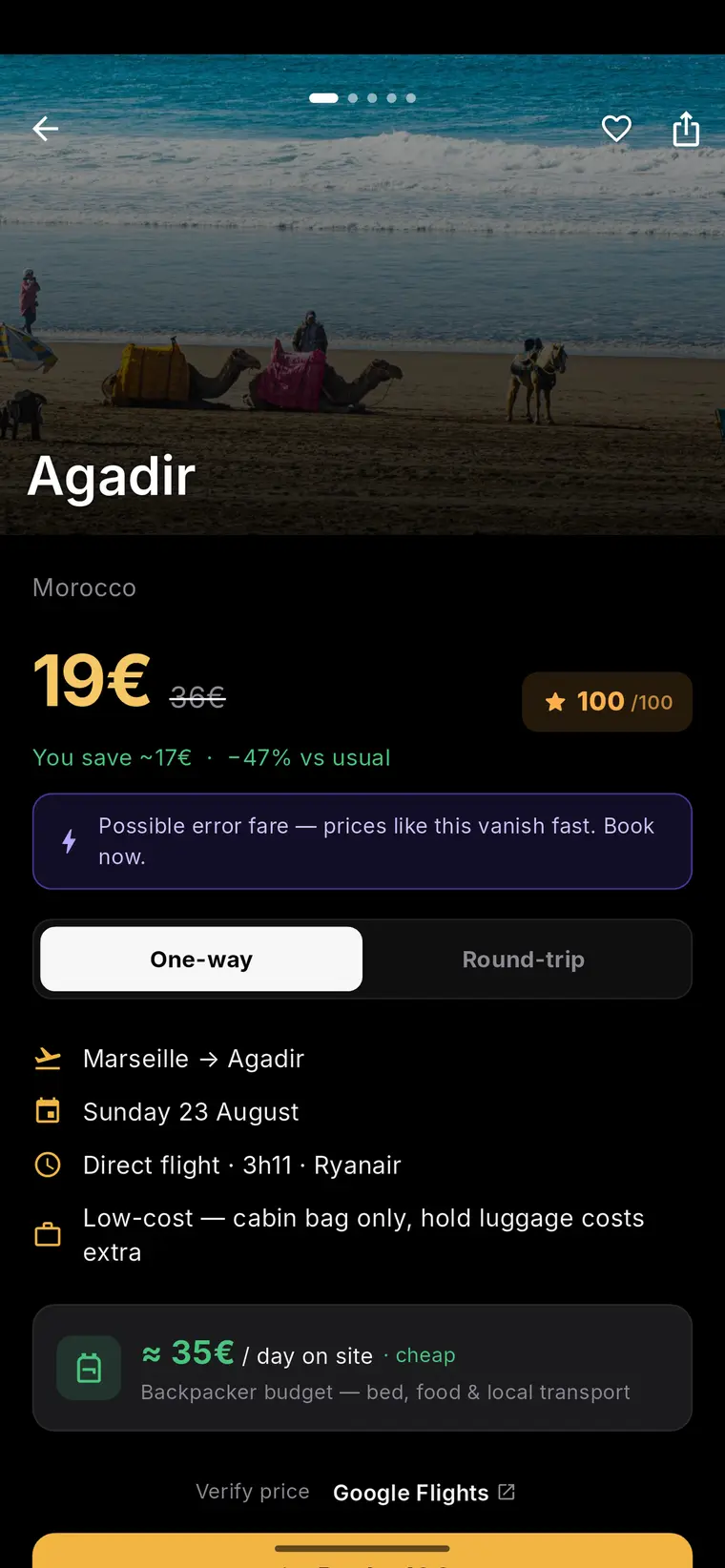
Flare is one example of this category. It publishes flight-deal discovery pages organised around a traveller's departure city, and its public methodology states that the deals it surfaces are detected at least 30% below the route reference price its monitoring uses. That threshold is a detection rule, not a promise about any specific fare you'll see when you check availability, and it's worth reading in that light.
Why the search intent behind flight price drop alert app matters
Searches for a flight price drop alert app are usually commercial investigation: someone wants to understand what these tools do, how reliable the alerts are, and whether it's worth the effort of setting one up before deciding which route or airline to actually book. That's a different question from 'find me the cheapest flight right now,' and it deserves a different kind of answer.
The honest answer is that no alert app, including Flare, can guarantee a fare will still be available or priced the same by the time you click through to book. Displayed fares and seat availability change continuously, and the booking provider's own system is the only source that can confirm what's actually purchasable at that instant. An alert is a prompt to look, not a locked-in price.
Reading a fare alert without over-trusting it
When an alert lands, treat it as a starting point for comparison rather than a final answer. A useful habit is to check the same route through more than one channel before booking. Google Travel, for instance, lets you track flights and prices directly and shows historical price context for a route, which can help you judge whether an alerted fare is unusually low or simply typical for that time of year.
Cross-referencing sources also protects you against a fare that looked good in an alert but has already moved by the time you open the airline's site. This isn't a flaw specific to any one app - it's a structural feature of how fares are priced and inventoried, and it applies whether the alert came from Flare, a browser tool, or a manual search.
Total-trip context matters here too. A price drop on the flight itself doesn't tell you anything about baggage fees, seat selection costs, layover length, or how the arrival time interacts with your onward plans. A fare that's 30% below a reference price on paper can still be a worse deal overall than a slightly higher fare with better routing or included baggage.
A worked example: comparing two alerts
Here is a hypothetical, for illustration only. Imagine you set up alerts for a departure city and receive two notifications in the same week: one for a nonstop flight at a fare flagged as below the app's reference threshold, and another for a one-stop itinerary at a similar headline price.
Before booking either, you might: open the airline's own site to confirm the fare and any restrictions (change fees, refundability, fare class); check total trip time including the layover, since a 'similar price' one-stop can add several hours; compare baggage inclusions, since a nonstop fare with no checked bag can end up costing more than an itinerary that includes one; and verify entry, passport, visa, or health requirements for your destination and any transit country, since these depend entirely on your nationality and itinerary and aren't something any fare-alert tool addresses.
This kind of side-by-side check takes a few minutes and turns a raw alert into an actual decision. It also protects you from anchoring on the headline percentage-off number, which describes how the deal was detected, not how it compares to every other option available to you that week.
Practical checklist before you act on an alert
A short, repeatable process helps more than trying to memorise every caveat. The following checklist applies regardless of which flight price drop alert app sent the notification.
- Confirm the current fare and seat availability directly with the airline or booking provider before paying.
- Compare the alerted fare against at least one other source, such as Google Travel's price tracking, to gauge whether it's genuinely favourable.
- Add total-trip costs - baggage, seat selection, layover time - before deciding a lower headline fare is the better option.
- Check current official entry, passport, visa, and health requirements for your destination and any transit points; these are traveller- and destination-specific and can change.
- Treat any 'X% below reference price' claim as a description of how a deal was surfaced, not a guarantee that it will still be that price when you go to buy.
Where the flexible-comparison approach helps most
Flight price drop alert apps are most useful to travellers who are flexible on dates, destinations, or both, since a wider comparison window increases the chance an alert actually reflects a meaningful anomaly rather than routine fare variation. If you're fixed on one exact date and route, an alert can still help, but the margin for a genuine 'deal' is narrower and you may see fewer notifications.
For flexible travellers, the practical approach is to let alerts narrow a broad set of options, then apply the same verification steps - checking the provider directly, comparing total trip cost, and confirming entry requirements - before committing. That combination of automated monitoring and manual confirmation is what keeps a fare alert useful rather than misleading.
Live destination map
Fare data meets travel intelligence
Move from a current fare signal to a photographed destination page, then use Flare guides to evaluate the complete trip.



Frequently asked questions
Does a flight price drop alert app guarantee the fare will still be available when I book?
No. Displayed fares and seat availability can change at any time, and only the airline or booking provider's own system can confirm what is actually purchasable when you go to pay. Treat any alert as a prompt to check, not a locked-in price.
What does it mean when an app says a deal is a certain percentage below the reference price?
It describes how that provider's monitoring flagged the fare relative to a route reference price in its own methodology, not a promise about future availability or a comparison against every other option on the market. It's useful context, but it should be checked against the current live fare before booking.
Do I still need to check visa or entry requirements if a fare alert app tells me about a deal?
Yes. Entry, passport, visa, and health requirements depend on your nationality, destination, and itinerary, and no fare-alert tool addresses them. Always verify current official requirements directly with the relevant government or embassy sources before booking or departing.
Sources and further reading
These resources provide the wider reference frame. Product statements on this page are limited to the public information provided by Flare.